As energy costs continue to rise and environmental concerns become more serious, businesses and households are actively searching for sustainable solutions. Biogas technology has emerged as one of the most effective ways to convert organic waste into clean, usable energy.
However, choosing the right type of plant is not a simple decision. Each system is designed for specific needs, and selecting the wrong one can lead to inefficiency and higher costs.
This guide will help you understand the different types of biogas plants and identify which one is best suited for your requirements.
What is a Biogas Plant?
A biogas plant is a system that converts organic waste such as food waste, agricultural residue, or animal dung into biogas through a process called anaerobic digestion.
The gas produced is rich in methane and can be used for cooking, heating, or electricity generation. In addition, the leftover slurry acts as a nutrient-rich organic fertilizer, making the process both economically and environmentally beneficial.
Types of Biogas Plants
1. Fixed Dome Biogas Plant
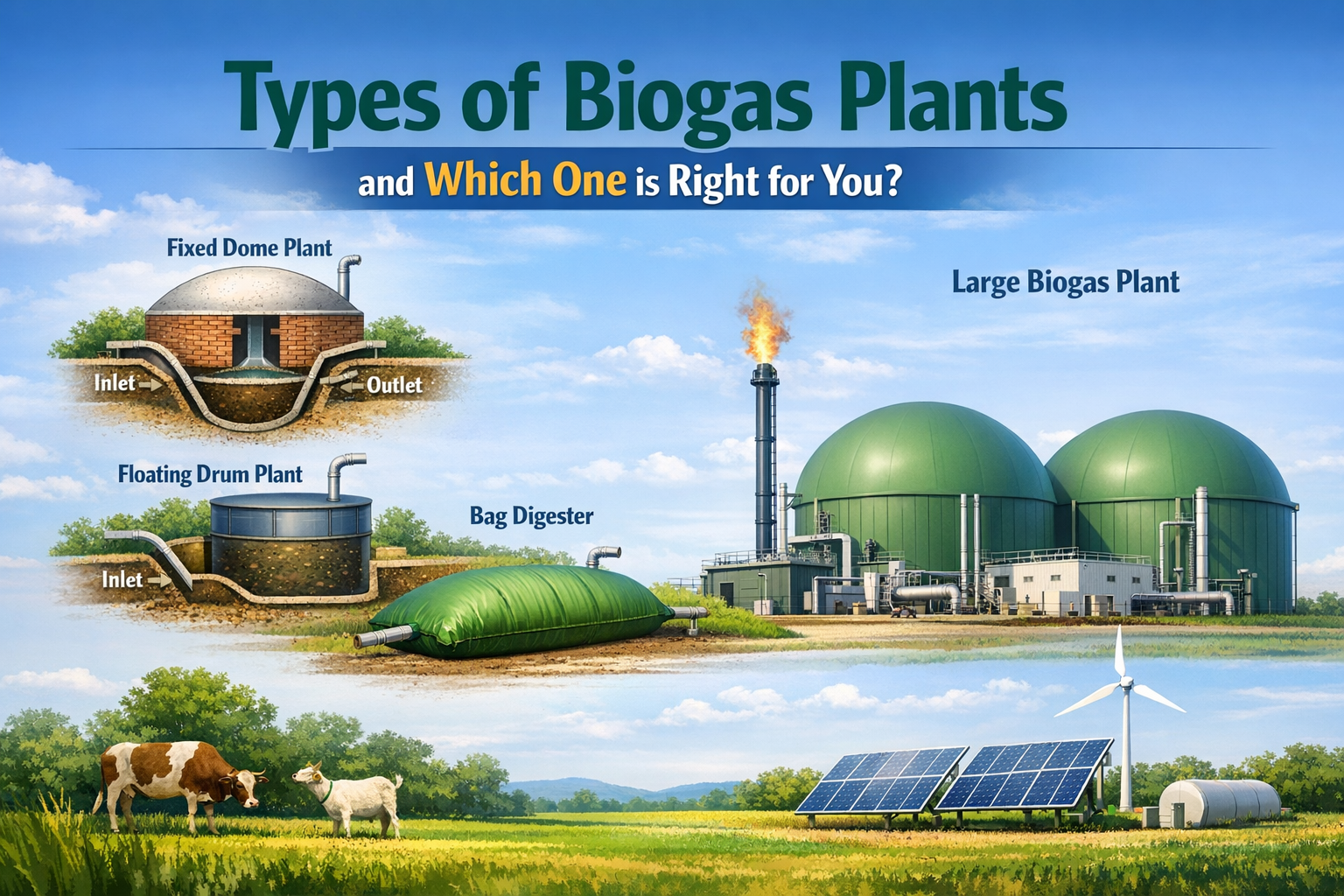
The fixed dome biogas plant is one of the oldest and most reliable designs. It consists of an underground digester and a dome-shaped gas storage chamber.
This system is highly durable because it has no moving parts, which reduces maintenance requirements. However, gas pressure may vary depending on production levels.
Best suited for: Rural households, farms, and long-term low-maintenance use.
2. Floating Drum Biogas Plant
In this design, gas is collected in a floating drum that rises and falls based on gas production. This ensures a consistent gas supply.
While it provides stable gas pressure, the metal drum is prone to corrosion, which can increase maintenance over time.
Best suited for: Small businesses and households requiring consistent gas output.
3. Balloon (Flexible Bag) Biogas Plant
This system uses a flexible bag made of plastic or rubber to store gas. It is lightweight, easy to install, and cost-effective.
However, it has a shorter lifespan and may be affected by environmental conditions.
Best suited for: Temporary setups, small-scale users, and low-budget installations.
4. Plug Flow Biogas Plant
The plug flow system consists of a long chamber where waste moves gradually from one end to the other. It is designed for continuous operation.
This type is highly efficient when handling large volumes of uniform organic waste, especially in agricultural setups.
Best suited for: Dairy farms, agricultural industries, and continuous waste generators.
5. Continuous Stirred Tank Reactor (CSTR)
The CSTR is an advanced biogas system used in industrial applications. It includes a mixing mechanism that ensures uniform digestion of waste.
This results in higher efficiency, better gas production, and controlled operations. However, it requires higher investment and technical expertise.
Best suited for: Hotels, food processing industries, municipalities, and large-scale commercial use.
How to Choose the Right Biogas Plant
Selecting the right biogas plant depends on multiple factors:
Type of Waste:
The kind of waste you generate—food waste, agricultural waste, or animal dung—plays a key role in deciding the plant type.
Scale of Operation:
Small households require simpler systems, while industries need advanced and high-capacity plants.
Budget:
Low-cost options like fixed dome and balloon plants are suitable for basic needs, while systems like CSTR offer better long-term returns despite higher initial investment.
Space Availability:
Underground plants require more construction space, whereas flexible systems need minimal infrastructure.
Maintenance Capability:
Some systems require minimal supervision, while others demand regular monitoring and technical expertise.
Conclusion
Biogas plants are a powerful solution for converting waste into energy while reducing fuel costs and environmental impact. However, the effectiveness of the system depends largely on choosing the right type of plant.
By carefully evaluating your waste generation, budget, and operational needs, you can invest in a system that delivers long-term savings and sustainability.
Final Thought
In today’s world, waste is not just waste—it is an opportunity. With the right biogas plant, you can turn everyday waste into a reliable energy source and contribute to a greener future.
For More Information:- https://thegreenplanetsolutions.com/blog/
Comments
2 responses to “How to Choose the Right Biogas Plant for Maximum Savings”
Ham Apne khet per 15 bigha Bhumi hai jis per bhai gas plant subsidy wala lagwane chahte Hain to hamen क्या-क्या kaarvayi कौन-कौन se paper ki avashyakta hogi tatha Kitna Paisa input karna padega hamen is sambandh mein jankari nahin Hai jankari purn tarah Se dene ki kripa Karen
आपकी बायोगैस प्लांट और सब्सिडी संबंधी जानकारी के लिए धन्यवाद। सही क्षमता, अनुमानित निवेश और आवश्यक दस्तावेजों पर मार्गदर्शन देने के लिए हमारी टीम को आपके राज्य, उपलब्ध जैविक अपशिष्ट की दैनिक मात्रा और उपयोग की आवश्यकता जाननी होगी। कृपया +91 7722073961 पर कॉल करें या inquiry@thegreenplanetsolutions.com पर ईमेल करें।