Tag: Organic Waste Management

  • Wet-Waste Management Plan for Housing Societies in India

    Wet-Waste Management Plan for Housing Societies in India

    Housing societies can make wet-waste handling more reliable when they treat it as an everyday operating process, rather than only an equipment purchase. A workable plan starts with knowing how much material is generated, where it is collected, who is responsible at each step, and what will happen to the processed material.

    This guide gives a practical structure for resident welfare associations, committee members, facility managers, and housekeeping teams. The exact system should be selected only after a site assessment, because quantity, available space, local collection arrangements, staffing, and local rules differ from one property to another.

    1. Estimate the daily wet-waste quantity

    Begin with a short measurement exercise. For seven representative days, ask the housekeeping team to separately record food scraps, fruit and vegetable waste, garden waste, and contaminated mixed waste from common areas. Record the approximate weight or number of containers, along with unusual events such as functions, holidays, or low occupancy.

    The objective is not a perfect laboratory measurement. It is to establish a realistic daily range and identify peak days. This information helps the society compare processing options and plan storage and collection capacity.

    Useful information to record includes:

    • number of occupied flats and approximate residents;
    • wet-waste quantity by day;
    • garden-waste quantity, if handled separately;
    • collection timings and collection-point location;
    • current municipal collection arrangement; and
    • available covered space, power, drainage, and staff availability.

    2. Make segregation simple for residents and staff

    Wet-waste processing works best when the input is reasonably clean. The society should make the expected household behaviour easy to understand: keep food waste separate from dry recyclables, sanitary waste, e-waste, glass, and hazardous items.

    Use clear bin labels with examples rather than only technical terms. Place the same instructions at lift lobbies, collection points, and in resident communication groups. Housekeeping staff should have a short, consistent procedure for what to do when a bag is mixed or contains unsuitable material.

    A short message, repeated consistently, is more useful than a detailed one-time circular.

    3. Design the collection point before selecting equipment

    A collection point should support safe, clean daily work. Confirm where waste will be brought, whether the area is covered, how containers will be cleaned, and how staff will move material without crossing inconvenient routes or creating odour issues near homes.

    Before commissioning any system, inspect:

    • access route from towers and common areas;
    • floor surface, water supply, drainage, and electrical connection where relevant;
    • ventilation and housekeeping arrangements;
    • distance from sensitive locations such as entrances, play areas, and windows; and
    • how the society will store material temporarily during maintenance or peak days.

    The best location is not necessarily the largest unused corner. It is a space that can be operated, cleaned, supervised, and accessed every day.

    4. Assign operating roles clearly

    Many projects slow down because the equipment is delivered but daily ownership is unclear. Write down who is responsible for collection, inspection of input material, loading, cleaning, record keeping, compost handling, and escalation when a problem occurs.

    For a typical society, the committee or facility manager can own oversight, while a named housekeeping supervisor owns the day-to-day checklist. The maintenance team should know whom to contact if power, drainage, or mechanical support is needed. The vendor or solution provider should be contacted through the agreed support route for issues that require specialist assistance.

    Keep a simple daily log. It can record approximate incoming quantity, contamination observed, operating time, output handling, and any issue requiring follow-up. The record is valuable during handover, committee changes, and performance reviews.

    5. Compare processing routes using site facts

    The right route depends on the actual site. Some societies may use an on-site organic-waste composter; others may use decentralised composting, authorised collection, or a combination with separate handling of garden waste. The choice should account for the expected quantity, space, staffing, budget, desired output, and the downstream use or removal of processed material.

    Do not select capacity using only the number of flats. Occupancy, food habits, events, common kitchens, and garden waste can change daily volumes. Use the measured daily range and allow for realistic operation and maintenance rather than assuming ideal input quality.

    For a starting point, review the Best Organic Waste Composter in India guide and the fully automatic composting machine solution page. A site discussion can then match the option to your actual operational requirements.

    6. Prepare a commissioning checklist

    Before the system begins regular operation, confirm that the society has:

    • a named owner for daily operation and another for backup;
    • resident and staff segregation instructions;
    • containers, cleaning materials, and personal protective equipment appropriate to the task;
    • a collection schedule and a covered temporary-holding arrangement;
    • an operating and maintenance checklist;
    • a plan for compost or processed output; and
    • a support and escalation contact path.

    Start with a supervised first week. Review the incoming material daily and solve contamination or collection problems early. A gradual, visible start usually produces better resident cooperation than silently launching a process and correcting it later.

    Common mistakes to avoid

    The most common issues are mixed waste at source, an inconvenient collection point, no named operator, unrealistic capacity assumptions, and no plan for the output. Another avoidable problem is treating resident communication as complete after one announcement. New residents, staff turnover, and changing habits mean the message needs occasional reinforcement.

    Request a practical site assessment

    Green Planet Solutions can discuss a suitable next step using your resident count, approximate daily wet-waste quantity, available space, city, and preferred operating model. Call +91 7722073961 or email inquiry@thegreenplanetsolutions.com. For a structured enquiry, use the existing project-enquiry route.

    This article is practical operational guidance. Confirm applicable local requirements and site-specific technical details before implementing a waste-management system.
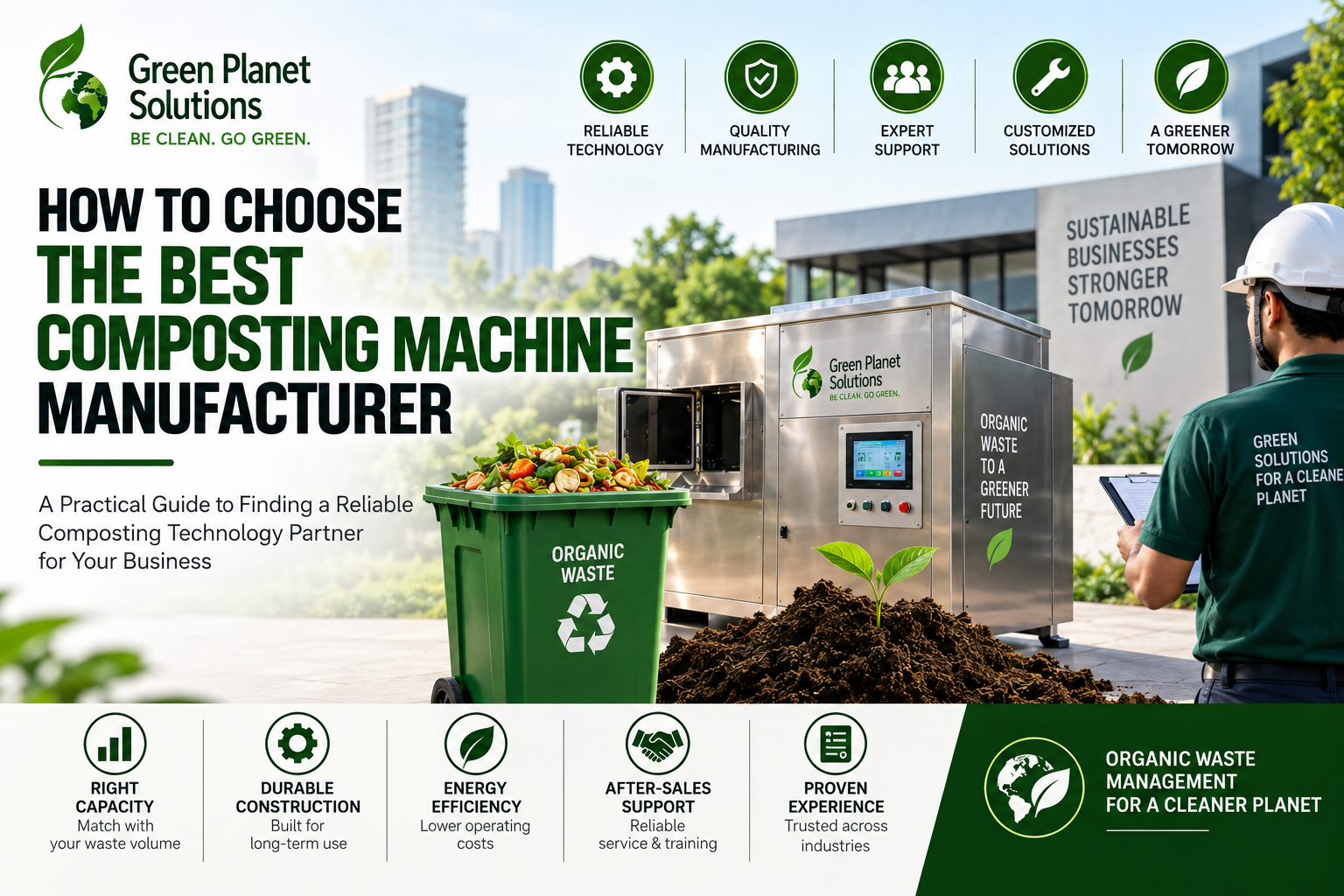
  • How to Choose the Best Composting Machine Manufacturer

    How to Choose the Best Composting Machine Manufacturer

    Practical Guide to Finding a Reliable Composting Technology Partner for Your Business

    Choosing the right composting machine manufacturer is an important decision for any organization looking to manage organic waste efficiently. A composting machine is a long-term investment, and the right manufacturer can make a major difference in machine performance, maintenance, operating costs, and overall return on investment.

    With many suppliers and technologies available in the market, businesses should look beyond the initial machine price. Factors such as technology, capacity, construction quality, customization, after-sales support, and manufacturer experience should all be considered before making a decision.


    Understand Your Organic Waste Requirements First

    Before contacting a manufacturer, understand how much organic waste your business generates every day.

    Hotels, restaurants, shopping malls, hospitals, residential communities, food courts, and industrial canteens can have very different waste volumes.

    Consider:

    • Average daily organic waste
    • Peak waste generation
    • Type of food waste
    • Available installation space
    • Operating hours
    • Expected composting output

    Having this information makes it easier for the manufacturer to recommend an appropriate machine capacity.


    1. Look for Relevant Industry Experience

    Experience matters when selecting a composting machine manufacturer.

    A manufacturer with experience across different industries is more likely to understand the practical challenges involved in handling organic waste.

    Look for manufacturers that have worked with applications such as hotels, restaurants, commercial complexes, residential societies, institutions, and industrial facilities.

    A strong track record can give you greater confidence in the technology and implementation process.


    2. Evaluate the Technology

    Not all composting machines operate in exactly the same way.

    Ask the manufacturer how their system handles important factors such as:

    • Temperature
    • Moisture
    • Aeration
    • Mixing
    • Odor management
    • Processing time
    • Organic waste characteristics

    A good manufacturer should be able to clearly explain how the technology works and why it is suitable for your application.


    3. Choose the Right Machine Capacity

    Capacity is one of the most important factors when purchasing a composting machine.

    A machine that is too small may struggle to handle your daily waste volume, while selecting an unnecessarily large system can increase your initial investment and operating costs.

    A reliable manufacturer should evaluate your actual waste generation and recommend an appropriately sized system rather than simply selling the largest available model.


    4. Check the Quality of Construction

    Composting machines used in commercial environments need to withstand continuous operation and exposure to organic material and moisture.

    Pay attention to:

    • Material of construction
    • Internal components
    • Motor and gearbox quality
    • Electrical components
    • Control panel
    • Safety systems
    • Overall machine design

    Durable construction can contribute to longer equipment life and more reliable performance.


    5. Ask About Automation

    Automation can make daily operation significantly easier.

    Modern commercial composting machines may include automated functions for mixing, temperature management, aeration, heating, and processing cycles.

    A user-friendly control system allows operators to monitor the machine without requiring extensive technical knowledge.

    When comparing manufacturers, ask which functions are automated and how much manual intervention is actually required.


    6. Consider Energy Consumption

    Energy consumption directly affects the long-term operating cost of a composting machine.

    Don’t focus only on the purchase price. Ask the manufacturer about expected power consumption under normal operating conditions.

    A slightly higher initial investment in an efficient system may provide better value over the machine’s operating life.


    7. Understand the Composting Process and Output

    Before purchasing a machine, understand what happens to the organic waste after processing.

    Ask questions such as:

    • What type of organic waste can be processed?
    • How long is the processing cycle?
    • What is the expected reduction in waste volume?
    • What type of material comes out of the machine?
    • Does the output require curing or maturation?
    • How should the final compost be handled?

    Understanding the complete process helps you set realistic expectations.


    8. Don’t Ignore Odor Management

    Odor is one of the biggest concerns when processing food waste, particularly in hotels, restaurants, malls, and residential communities.

    A good composting system should have an appropriate approach to odor management. However, machine design is only one part of the solution.

    Proper waste segregation, loading practices, moisture management, ventilation, and regular maintenance also play important roles.

    Ask the manufacturer how their system manages odors and what operating practices are recommended.


    9. Check Installation and Space Requirements

    Before finalizing a machine, make sure it fits your facility.

    Consider:

    • Machine dimensions
    • Loading area
    • Output collection area
    • Electrical requirements
    • Ventilation
    • Access for maintenance
    • Movement of waste to the machine

    A professional manufacturer should provide clear installation requirements and help determine whether the available space is suitable.


    10. Evaluate After-Sales Support

    Buying the machine is only the beginning of the relationship.

    Reliable after-sales support is essential for long-term performance.

    Ask whether the manufacturer provides:

    • Installation support
    • Commissioning
    • Operator training
    • Preventive maintenance
    • Spare parts
    • Technical assistance
    • Warranty support
    • Annual Maintenance Contracts (AMC)

    A manufacturer with strong service support can help minimize downtime and keep the machine operating efficiently.


    11. Ask for References or Project Experience

    Before making a final decision, ask the manufacturer about previous installations.

    Where possible, understand:

    • Type of customer
    • Industry
    • Machine capacity
    • Application
    • Operating conditions
    • Customer experience

    Real-world installations can provide valuable insight into how the machine performs outside a showroom or product demonstration.


    12. Compare Total Cost of Ownership

    The cheapest machine is not necessarily the most economical option.

    When comparing manufacturers, consider the total cost of ownership, including:

    Purchase Cost + Installation + Energy + Maintenance + Spare Parts + Service

    A reliable machine with efficient operation and strong after-sales support may provide better long-term value than a low-cost machine with frequent maintenance requirements.


    Questions to Ask Before Buying

    Before selecting a manufacturer, consider asking:

    1. What capacity is suitable for my waste volume?
    2. What types of organic waste can the machine process?
    3. How does the machine control temperature and moisture?
    4. What level of automation is provided?
    5. What is the expected processing cycle?
    6. What type of output should I expect?
    7. What are the power requirements?
    8. What maintenance is required?
    9. What warranty and service support are included?
    10. Are spare parts readily available?
    11. Can the machine be customized?
    12. Do you provide installation and operator training?

    A manufacturer that provides clear and practical answers is generally easier to work with in the long term.


    Why Green Planet Solutions?

    Green Planet Solutions provides commercial organic waste management solutions designed for businesses and institutions looking to process biodegradable waste more efficiently.

    Our composting machines are designed for applications across hotels, restaurants, shopping malls, food courts, residential communities, hospitals, institutions, and commercial facilities.

    We focus on practical machine selection, reliable operation, automation, durable construction, and customer support. Our team can help businesses evaluate their waste generation and identify a suitable composting solution based on their operational requirements.


    For a suitable composting-machine recommendation, share your daily organic-waste quantity, site type, available space, and location with Green Planet Solutions at +91 7722073961 or inquiry@thegreenplanetsolutions.com.

    Conclusion

    Choosing the best composting machine manufacturer is about more than comparing machine prices. The right decision requires looking at technology, capacity, construction quality, automation, energy consumption, output, installation requirements, and after-sales support.

    A reliable manufacturer should act as a long-term technology partner—not simply a machine supplier.

    By evaluating these factors carefully, businesses can select a composting solution that supports efficient organic waste management, reduces disposal requirements, and contributes to their sustainability goals.

    Choose the Right Technology. Partner with the Right Manufacturer.

    With the right composting machine and professional support, your business can turn organic waste management from a daily challenge into a practical step toward a cleaner, greener, and more sustainable future.

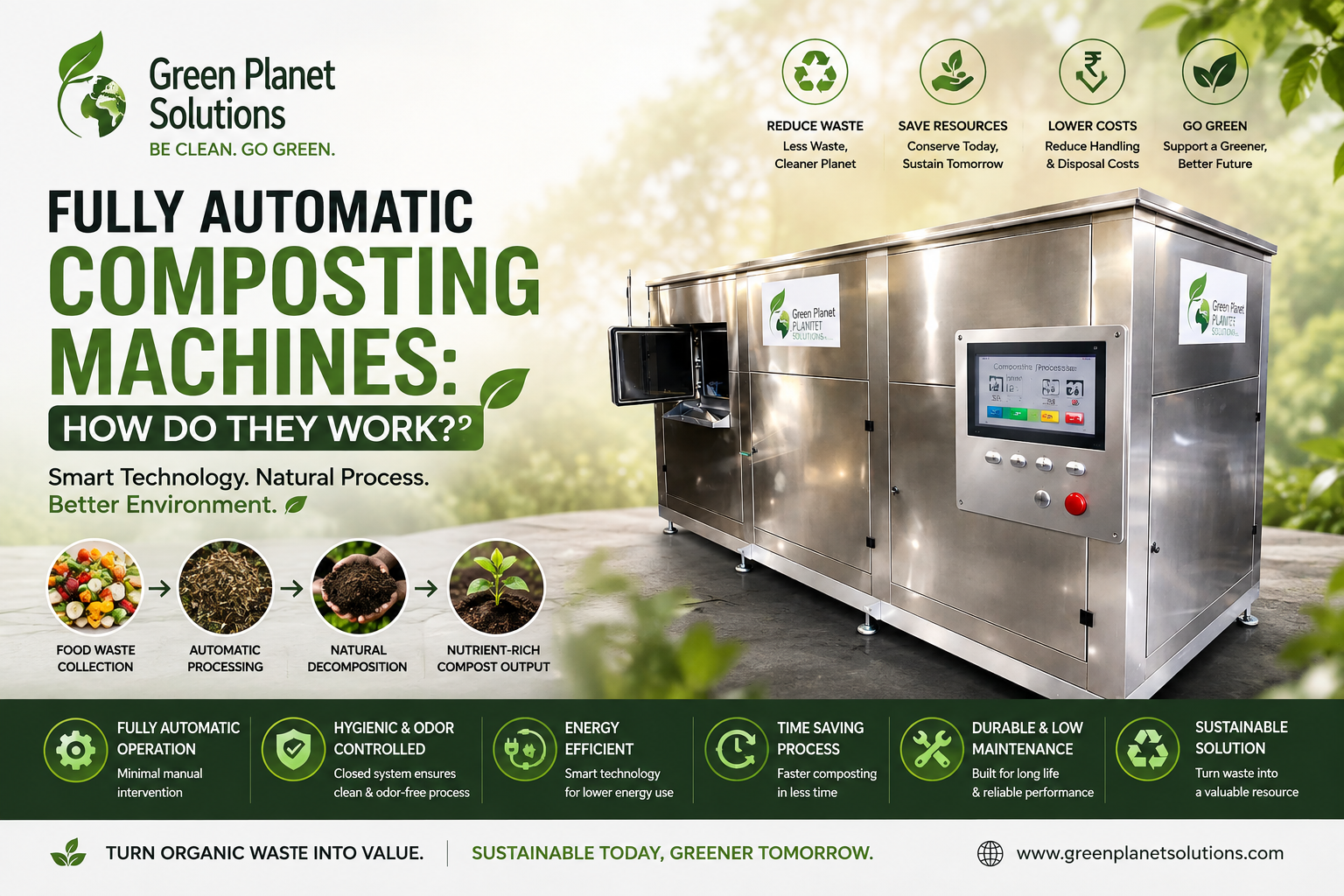
  • Fully Automatic Composting Machine: How Do They Work?

    Fully Automatic Composting Machine: How Do They Work?

    A Simple Guide to Turning Organic Waste into Compost with Automated Technology

    Managing food and organic waste has become a growing challenge for hotels, restaurants, shopping malls, hospitals, residential communities, institutions, and commercial facilities. Sending this waste to landfills takes up valuable space, increases transportation requirements, and can create unpleasant odors and environmental concerns. A fully automatic composting machine offers a smarter approach. It processes organic waste on-site and accelerates the natural composting process with controlled temperature, moisture, airflow, and mixing. The result is partially or fully stabilized compost-like organic material, depending on the machine and process used.


    What Is a Fully Automatic Composting Machine?

    A fully automatic composting machine is an enclosed system designed to process biodegradable waste with minimal manual intervention.

    Food scraps, vegetable and fruit waste, and other suitable organic materials are loaded into the machine. Automated systems then control important operating conditions to support microbial decomposition.

    Unlike traditional open composting, the process takes place inside a controlled environment, making it easier to manage space, hygiene, odors, and day-to-day operations.


    How Does a Fully Automatic Composting Machine Work?

    The exact process varies depending on the machine design, but most systems follow a series of basic steps.

    Step 1: Organic Waste Is Collected

    The process begins with collecting suitable biodegradable waste from kitchens, restaurants, cafeterias, food courts, or other waste-generating areas.

    Waste should ideally be separated at the source to prevent plastic, glass, metal, and other non-biodegradable materials from entering the composting system.


    Step 2: Waste Is Loaded into the Composting Machine

    The segregated organic waste is placed into the machine through its designated loading chamber.

    Depending on the equipment design and capacity, the machine can handle different quantities of organic waste per day. Selecting the appropriate capacity is important to avoid overloading and maintain consistent performance.


    Step 3: Shredding and Mixing

    Some composting systems use a shredding or grinding mechanism to reduce the size of organic waste.

    Smaller particles provide a more uniform material and can help microorganisms access the organic matter more easily.

    The waste may then be mixed to create a more consistent composting environment.


    Step 4: Controlled Decomposition

    This is the main stage of the process.

    Microorganisms naturally break down organic matter. The machine helps create favorable conditions by controlling factors such as temperature, moisture, airflow, and mixing.

    Some systems use automated heating or aeration to maintain appropriate conditions, depending on their design.


    Step 5: Moisture and Temperature Management

    Moisture and temperature have a direct influence on biological decomposition.

    Too much moisture can affect airflow, while insufficient moisture can slow microbial activity. Similarly, temperature changes can influence the rate and consistency of decomposition.

    Automated monitoring and control help maintain suitable conditions during the process.


    Step 6: Odor Management

    One of the common concerns with food waste is unpleasant odor.

    Enclosed composting machines can incorporate ventilation and odor-control systems to help manage emissions from the process. Proper waste segregation, loading practices, airflow, and regular maintenance are also important for effective odor management.


    Step 7: Compost Output

    After the processing cycle, the organic material is removed from the machine.

    Depending on the technology and process duration, the output may require curing, maturation, screening, or further processing before it is used as finished compost.

    The final material can be useful for landscaping, gardening, soil improvement, or other appropriate applications, subject to its quality and local requirements.


    What Makes the Composting Machine “Fully Automatic”?

    The main advantage of automation is reduced manual involvement.

    Depending on the model, automated features may include:

    • Automatic mixing
    • Temperature monitoring
    • Automated heating
    • Moisture management
    • Airflow or aeration control
    • Programmable processing cycles
    • Touchscreen controls
    • Safety alerts
    • Automatic operating sequences

    These features allow operators to monitor the process rather than manually manage every stage.


    Benefits of Fully Automatic Composting Machine

    1. Reduces Organic Waste Sent to Landfills

    Processing organic waste on-site can significantly reduce the amount of biodegradable material that needs to be transported for disposal.

    2. Saves Space

    Because the process takes place inside an enclosed machine, it can be suitable for facilities where traditional composting requires too much space.

    3. Reduces Manual Work

    Automation reduces the need for continuous manual handling and monitoring, making daily waste management easier for facility teams.

    4. Helps Control Odors

    Enclosed processing and appropriate odor-control systems can make organic waste management more suitable for commercial environments.

    5. Supports Sustainability Goals

    Converting organic waste into a useful resource supports circular economy practices and can contribute to an organization’s broader sustainability objectives.

    6. Creates a Useful Organic Resource

    Instead of treating food waste simply as something to throw away, composting allows businesses to recover value from biodegradable material.


    Where Can Fully Automatic Composting Machine Be Used?

    These machines can be suitable for many waste-generating facilities, including:

    • Hotels and Resorts
    • Restaurants and Cafés
    • Shopping Malls and Food Courts
    • Hospitals
    • Residential Communities
    • Corporate Offices
    • Universities and Schools
    • Industrial Canteens
    • Food Processing Facilities
    • Municipal and Institutional Projects

    The right machine depends on the quantity and type of organic waste generated at the facility.


    How to Choose the Right Composting Machine

    Before purchasing a composting machine, businesses should consider more than just the machine’s capacity.

    Important factors include:

    Waste Quantity

    Estimate the average amount of organic waste generated per day rather than selecting equipment based only on occasional peak volumes.

    Type of Organic Waste

    Understand whether the waste consists mainly of cooked food, vegetable scraps, fruit waste, garden waste, or a combination of materials.

    Available Space

    Consider the machine’s dimensions, loading area, output area, electrical requirements, and space needed for maintenance.

    Processing Time

    Different technologies and machines have different processing cycles. Understand the expected output and whether additional curing or maturation is required.

    Energy Consumption

    Compare power requirements and operating costs before making a decision.

    Maintenance and After-Sales Support

    Reliable technical support, spare parts availability, operator training, and preventive maintenance can make a significant difference over the machine’s operating life.


    Why Businesses Are Moving Toward On-Site Composting

    For businesses that generate organic waste every day, transporting waste away from the facility is not always the most efficient long-term solution.

    On-site composting brings waste processing closer to the point of generation. This can reduce waste transportation requirements while giving organizations greater control over their organic waste management.

    It also provides a visible sustainability initiative that can support environmental programs and corporate responsibility efforts.


    Why Choose Green Planet Solutions?

    Green Planet Solutions provides commercial composting solutions designed for organizations looking for efficient and sustainable organic waste management.

    Our composting machines are designed with automation, controlled processing, durable construction, and practical operation in mind. We work with businesses across different sectors to identify suitable composting solutions based on their waste quantity, application, available space, and operational requirements.

    From equipment selection to installation and support, Green Planet Solutions helps businesses take a practical step toward responsible organic waste management.

    Buyer FAQ

    What capacity should I choose?

    Select capacity from the average daily quantity of segregated organic waste, rather than occasional peak volumes.

    What should be checked before installation?

    Confirm the waste type, available space, loading and maintenance access, and electrical requirements before selecting a machine.

    What details help Green Planet Solutions recommend a solution?

    Share the daily waste quantity, site type, location, and operating requirements so the recommended solution matches your application.

    Need a fully automatic composting machine for your site? Share your daily organic-waste quantity, waste type, facility type, available space, city, and requirements with Green Planet Solutions at +91 7722073961 or inquiry@thegreenplanetsolutions.com.


    Conclusion

    Fully automatic composting machines are changing the way businesses manage organic waste. By combining controlled biological decomposition with automation, these systems make it easier to process food waste on-site while reducing landfill dependency and supporting sustainability.

    The key is choosing a machine that matches your waste quantity, waste type, space, processing requirements, and operating goals.

    For businesses looking to turn organic waste into a useful resource, a well-designed composting system can be an important part of a cleaner and more sustainable waste management strategy.

    Turn Organic Waste into a Sustainable Resource

    With the right technology and responsible waste segregation, businesses can reduce waste, improve operational efficiency, and move closer to a cleaner, greener future with Green Planet Solutions.

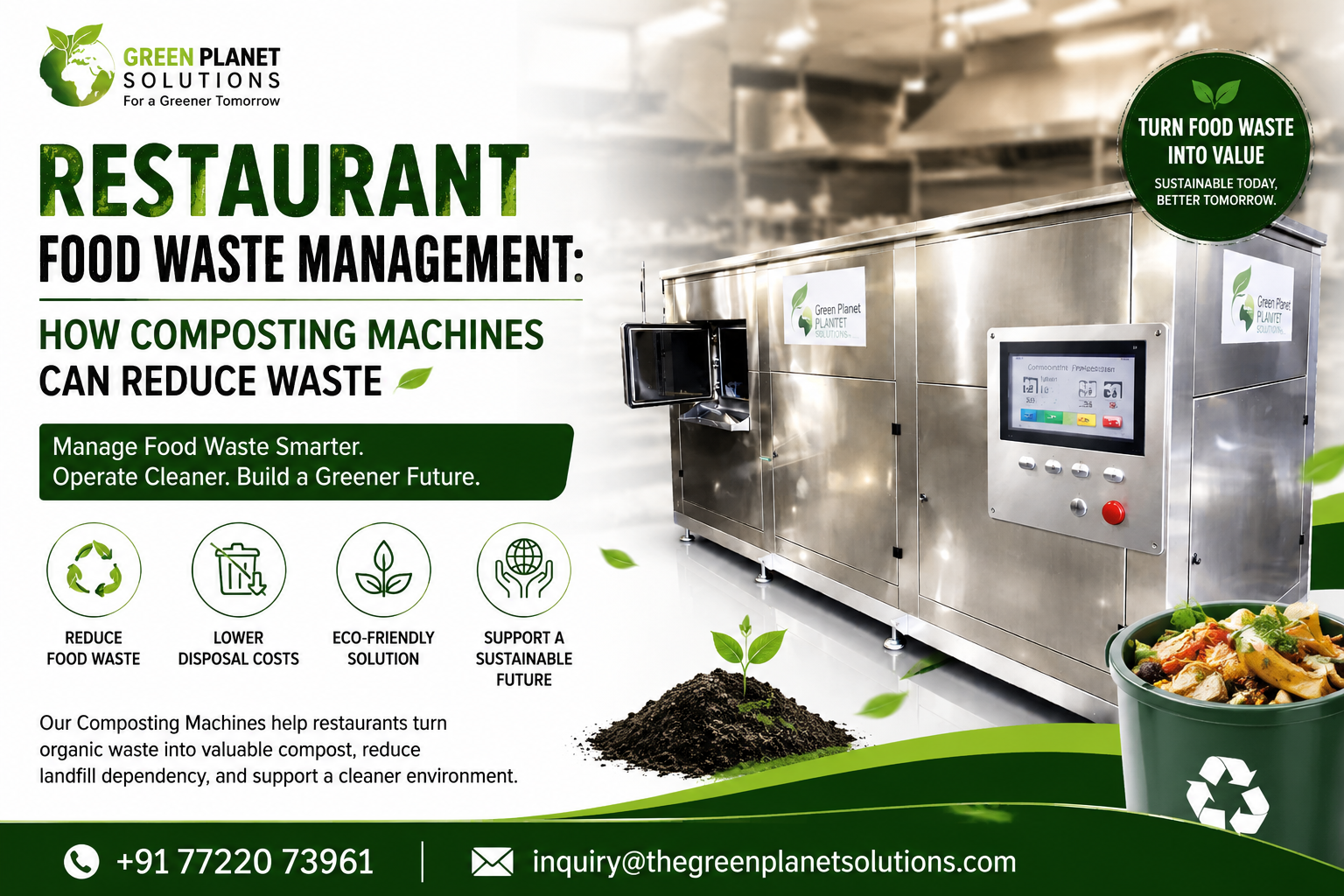
  • Restaurant Food Waste Management: How Composting Machines Can Reduce Waste

    Restaurant Food Waste Management: How Composting Machines Can Reduce Waste

    Turning Restaurant Food Waste into a Sustainable Resource

    Restaurants generate a significant amount of organic waste every day. Vegetable peels, leftover food, fruit waste, spoiled ingredients, and kitchen scraps can quickly accumulate. When this waste is sent to landfills, it can create unpleasant odors, attract pests, and contribute to environmental problems. With the right waste management approach, however, restaurants can turn much of this organic waste into a useful resource.

    Composting machines provide a practical solution by allowing restaurants to process food waste on-site and significantly reduce the amount of organic waste that needs to be transported and disposed of.

    Why Food Waste Management Matters for Restaurants

    Managing food waste is not only an environmental responsibility but also an important operational challenge. Restaurants need to deal with waste every day, and traditional disposal methods can increase collection, transportation, and waste-management costs.

    Poorly managed food waste can also create hygiene issues, unpleasant smells, and pest problems around kitchen and waste-storage areas. A well-planned food waste management system helps restaurants maintain cleaner operations while supporting their sustainability goals.

    How a Composting Machine Works

    A composting machine is designed to process organic food waste through a controlled treatment process. Depending on the machine and technology used, the food waste can be broken down and converted into a dry or compost-like organic output within a significantly shorter period than traditional composting.

    The process generally begins with collecting food waste from the kitchen and segregating it from plastics, metals, and other non-organic materials. The organic waste is then placed into the composting machine, where controlled conditions help accelerate its decomposition.

    The resulting material can be further processed or matured depending on the system and can potentially be used as an organic soil amendment.

    Reducing the Volume of Food Waste

    One of the biggest advantages of composting machines is their ability to reduce the volume of organic waste that restaurants send for external disposal.

    Instead of storing large quantities of food waste for daily collection, restaurants can process their organic waste on-site. This can reduce the frequency and volume of waste transportation and make waste handling easier for kitchen and facility-management teams.

    For restaurants that generate large quantities of food waste, this can make a noticeable difference in their overall waste-management process.

    Improving Kitchen Hygiene

    Food waste can become a hygiene concern when it remains in bins for long periods. Decomposing food can produce strong odors and attract insects and other pests.

    By processing organic waste regularly, restaurants can minimize the amount of food waste stored around their premises. This can contribute to cleaner waste-storage areas and a more hygienic working environment for employees.

    Supporting Sustainable Restaurant Operations

    Consumers are increasingly interested in businesses that take sustainability seriously. Restaurants can demonstrate their environmental commitment by adopting responsible food-waste management practices.

    Using a composting machine can become part of a broader sustainability strategy that includes food-waste reduction, recycling, responsible sourcing, energy efficiency, and water conservation.

    Rather than treating food waste only as something to be discarded, restaurants can take a circular approach by recovering value from organic waste.

    Potential Cost Savings

    Food waste disposal involves more than the cost of garbage collection. Restaurants may also spend money on waste storage, transportation, collection frequency, and facility maintenance.

    On-site composting can help reduce the quantity of organic waste requiring external disposal. Depending on the restaurant’s waste volume, local disposal costs, and operating conditions, this may create opportunities for long-term savings.

    The financial benefits should be evaluated based on factors such as daily waste generation, machine capacity, electricity consumption, maintenance requirements, and current waste-disposal costs.

    Choosing the Right Composting Machine

    Every restaurant has different waste-generation patterns, so choosing the right composting machine is important. Businesses should consider their average daily food-waste volume, available installation space, processing capacity, operating requirements, and type of organic waste generated.

    Restaurants should also consider whether they need a semi-automatic or fully automatic system. A properly sized machine can help ensure efficient operation without unnecessary investment in excess capacity.

    Composting Machines for Hotels, Restaurants and Commercial Kitchens

    Large hotels, restaurants, food courts, catering facilities, and institutional kitchens can generate substantial quantities of organic waste every day. For these businesses, an on-site composting solution can provide a structured way to manage food waste closer to its source.

    Instead of transporting large quantities of organic waste away from the property, businesses can process it on-site and reduce their dependence on conventional waste-disposal methods.

    Building a More Sustainable Food System

    Food waste management is becoming an important part of sustainable business operations. Restaurants have an opportunity to reduce waste at multiple stages—from better purchasing and portion control to food donation, recycling, and composting.

    A composting machine does not replace efforts to prevent food waste, but it can play an important role in managing unavoidable organic waste responsibly.

    Restaurant Food-Waste FAQ

    Can a restaurant process all kitchen waste?

    Process properly segregated organic waste only, and keep plastics, metal, glass, and other non-organic materials out of the machine.

    How should a restaurant choose capacity?

    Choose capacity from the average daily quantity of organic waste, rather than occasional peak volumes.

    What details help select a solution?

    Share the site type, daily organic-waste quantity, available space, location, and operating requirements.

    Need a composting system for your hotel, restaurant, mall, or food court? Share your daily organic-waste quantity, available installation space, and location with Green Planet Solutions at +91 7722073961 or inquiry@thegreenplanetsolutions.com.

    Conclusion

    Restaurant food waste is an everyday challenge, but it can also become an opportunity for more sustainable operations. Composting machines allow restaurants to process organic waste on-site, reduce the volume of waste sent for disposal, improve waste-handling conditions, and potentially reduce long-term disposal costs.

    For restaurants looking to adopt a more sustainable approach to organic waste management, investing in the right composting technology can be an important step toward a cleaner and more resource-efficient operation.

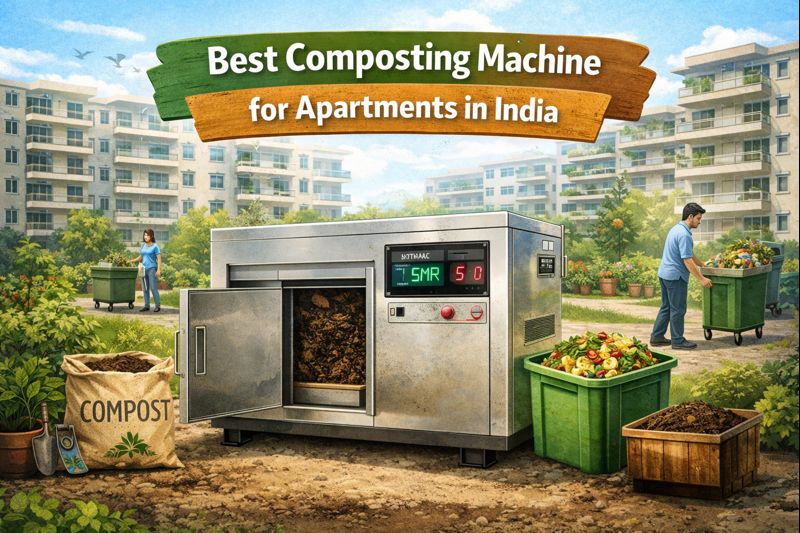
  • Best Composting Machine for Apartments in India

    Best Composting Machine for Apartments in India

    Table Of Contents:

    1. Introduction
    2. Why Apartments in India Need a Composting Machine
    3. What Is a Composting Machine for Apartments?
    4. Types of Composting Machines Used in Apartments
    5. Best Composting Machine for Apartments in India – Key Factors to Consider
    6. Benefits of Using a Composting Machine in Apartments
    7. How Much Does a Composting Machine Cost in India?
    8. Why Fully Automatic Composting Machines Are Popular in Apartments
    9. FAQs
    10. Conclusion
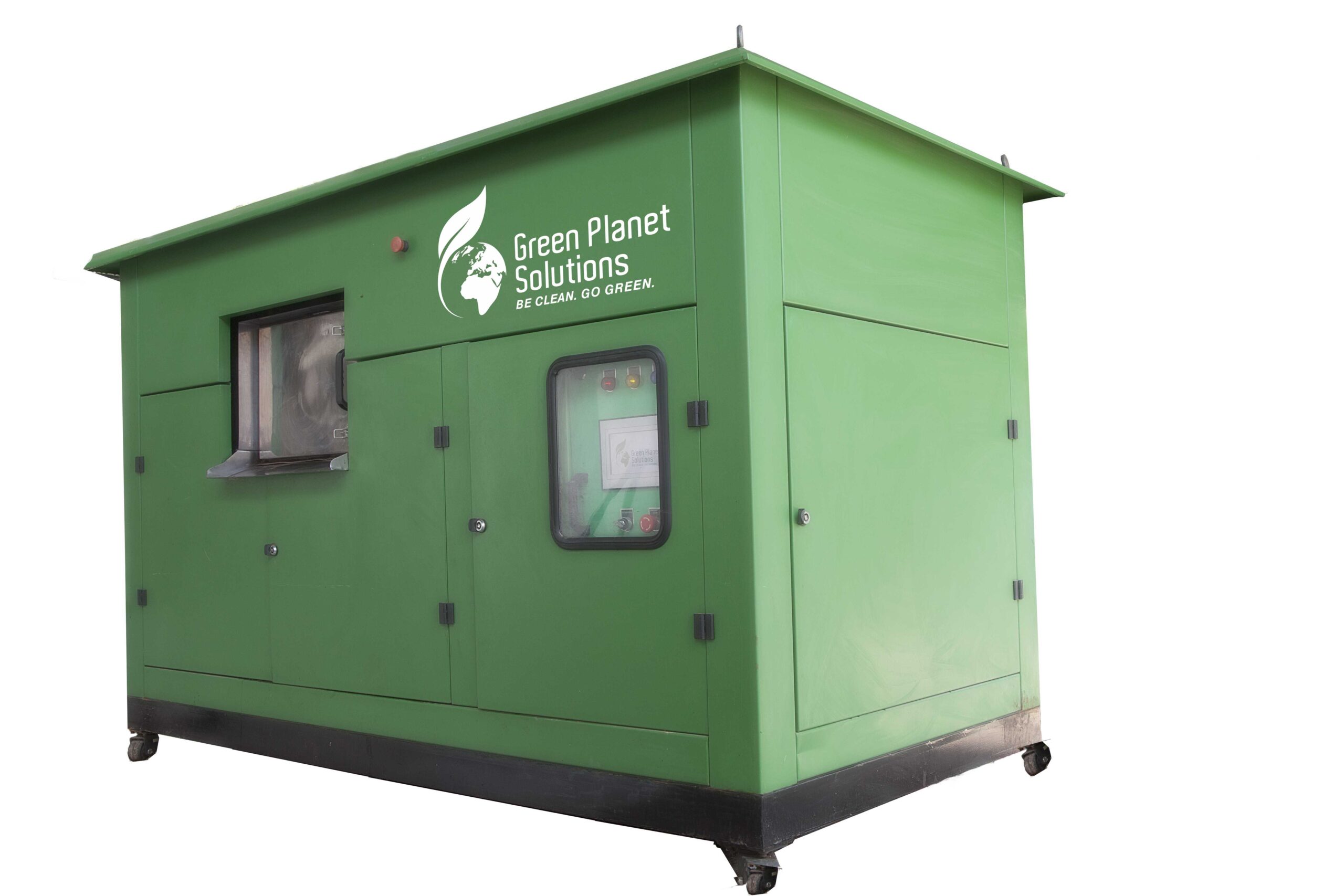
    Green planet solution's composting machine

    Introduction

    Using a composting machine for apartments is one of the best ways to solve this problem. Modern solutions like a Fully automatic composting machine help convert food waste into useful manure right inside the society premises. This not only reduces garbage but also supports a clean and green environment.

    With growing cities and apartment living, managing daily kitchen waste has become a big challenge. Most apartment societies in India generate large amounts of wet waste every day, which often ends up in landfills.

    In this blog, we will explain how to choose the best composting machine for apartments in India in a very simple and easy way.

    Why Apartments in India Need a Composting Machine

    • Apartments generate 50–60% organic waste
    • Government bodies encourage on-site waste processing
    • Reduces dependency on waste collectors
    • Saves money on garbage handling
    • Produces natural compost for gardens

    A good composting machine makes waste management easy and hygienic for apartment residents.

    What Is a Composting Machine for Apartments?

    A composting machine for apartments is a system designed to process daily food waste like:

    • Vegetable peels
    • Leftover food
    • Fruit waste
    • Garden waste

    It converts waste into compost using natural processes like heat, aeration, and mixing.

    Types of Composting Machines Used in Apartments

    1. Fully Automatic composting machine for apartments

    A Fully automatic composting machine works with minimum human effort.

    Features:

    • Automatic mixing and heating
    • Faster composting (24–48 hours)
    • Odor control system
    • Compact design

    Best For:

    • Large apartment societies
    • High daily waste generation
    • Low manpower availability

    2. Semi Automatic Composting Systems for apartments

    These systems require some manual operation.

    Features:

    • Lower cost
    • Manual mixing
    • Low electricity usage

    Best For:

    • Small apartments
    • Limited budgets

    Best Composting Machine for Apartments in India – Key Factors to Consider

    1. Daily Waste Quantity

    Choose a composting machine based on how much waste your apartment generates daily.

    2. Available Space

    Some machines are compact, while others need open areas.

    3. Electricity Consumption

    A Fully automatic composting machine requires power, so energy efficiency matters.

    4. Budget

    Balance between cost, features, and long-term savings.

    5. Maintenance Support

    Choose manufacturers who provide service and training.

    Benefits of Using a Composting Machine in Apartments

    • Reduces landfill waste
    • No bad smell when operated correctly
    • Converts waste into useful manure
    • Improves cleanliness
    • Supports sustainability goals
    • Encourages eco-friendly habits among residents

    How Much Does a Composting Machine Cost in India?

    Approximate price ranges:

    • Small capacity machines: ₹2–5 lakh
    • Medium capacity machines: ₹5–10 lakh
    • Large Fully automatic composting machines: ₹10 lakh and above

    Prices depend on capacity, technology, and features.

    Why Fully Automatic Composting Machines Are Popular in Apartments

    • Faster waste processing
    • Minimal human involvement
    • Cleaner operation
    • Suitable for urban living

    This makes a Fully automatic composting machine a preferred choice for modern apartment complexes.

    FAQs

    1. What is the best composting machine for apartments?

    The best composting machine for apartments is the Fully Automatic Composting Machine, which is suitable for large apartments, while semi-automatic composting machines are suitable for smaller societies.

    2. Does a composting machine have an odor?

    No. A composting machine does not have an odor if used properly.

    3. How long does the composting process take?

    The composting process takes 24-48 hours in Fully Automatic Composting Machines, while it takes longer in other machines.

    4. Is the compost safe to use?

    Yes. The compost is safe to use in gardens and on plants.

    5. Can apartments dispose of waste without a composting machine?

    Yes. A composting machine can make waste disposal easier, cleaner, and more economical.

    Conclusion

    Apartment waste management does not have to be a problem. A good composting machine for apartments can help to change kitchen waste into compost rather than dumping it in landfills.

    The best Fully automatic composting machine or composting system depends on the amount of waste being produced. With the right equipment, apartments can remain clean, save money, and protect the environment.

    A good composting machine is more than just a machine; it is a start towards a greener tomorrow.