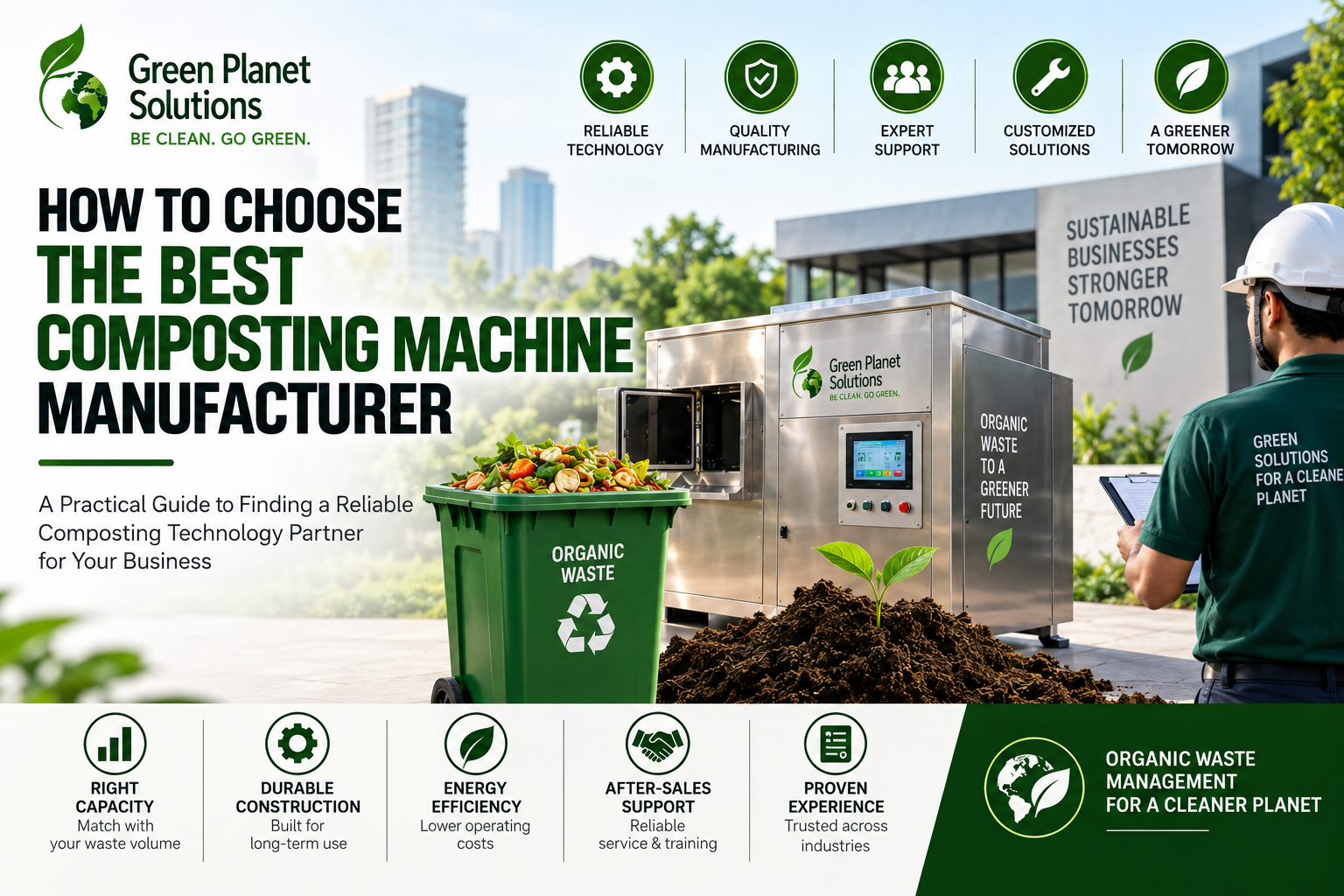
Practical Guide to Finding a Reliable Composting Technology Partner for Your Business
Choosing the right composting machine manufacturer is an important decision for any organization looking to manage organic waste efficiently. A composting machine is a long-term investment, and the right manufacturer can make a major difference in machine performance, maintenance, operating costs, and overall return on investment.
With many suppliers and technologies available in the market, businesses should look beyond the initial machine price. Factors such as technology, capacity, construction quality, customization, after-sales support, and manufacturer experience should all be considered before making a decision.
Understand Your Organic Waste Requirements First
Before contacting a manufacturer, understand how much organic waste your business generates every day.
Hotels, restaurants, shopping malls, hospitals, residential communities, food courts, and industrial canteens can have very different waste volumes.
Consider:
- Average daily organic waste
- Peak waste generation
- Type of food waste
- Available installation space
- Operating hours
- Expected composting output
Having this information makes it easier for the manufacturer to recommend an appropriate machine capacity.
1. Look for Relevant Industry Experience
Experience matters when selecting a composting machine manufacturer.
A manufacturer with experience across different industries is more likely to understand the practical challenges involved in handling organic waste.
Look for manufacturers that have worked with applications such as hotels, restaurants, commercial complexes, residential societies, institutions, and industrial facilities.
A strong track record can give you greater confidence in the technology and implementation process.
2. Evaluate the Technology
Not all composting machines operate in exactly the same way.
Ask the manufacturer how their system handles important factors such as:
- Temperature
- Moisture
- Aeration
- Mixing
- Odor management
- Processing time
- Organic waste characteristics
A good manufacturer should be able to clearly explain how the technology works and why it is suitable for your application.
3. Choose the Right Machine Capacity
Capacity is one of the most important factors when purchasing a composting machine.
A machine that is too small may struggle to handle your daily waste volume, while selecting an unnecessarily large system can increase your initial investment and operating costs.
A reliable manufacturer should evaluate your actual waste generation and recommend an appropriately sized system rather than simply selling the largest available model.
4. Check the Quality of Construction
Composting machines used in commercial environments need to withstand continuous operation and exposure to organic material and moisture.
Pay attention to:
- Material of construction
- Internal components
- Motor and gearbox quality
- Electrical components
- Control panel
- Safety systems
- Overall machine design
Durable construction can contribute to longer equipment life and more reliable performance.
5. Ask About Automation
Automation can make daily operation significantly easier.
Modern commercial composting machines may include automated functions for mixing, temperature management, aeration, heating, and processing cycles.
A user-friendly control system allows operators to monitor the machine without requiring extensive technical knowledge.
When comparing manufacturers, ask which functions are automated and how much manual intervention is actually required.
6. Consider Energy Consumption
Energy consumption directly affects the long-term operating cost of a composting machine.
Don’t focus only on the purchase price. Ask the manufacturer about expected power consumption under normal operating conditions.
A slightly higher initial investment in an efficient system may provide better value over the machine’s operating life.
7. Understand the Composting Process and Output
Before purchasing a machine, understand what happens to the organic waste after processing.
Ask questions such as:
- What type of organic waste can be processed?
- How long is the processing cycle?
- What is the expected reduction in waste volume?
- What type of material comes out of the machine?
- Does the output require curing or maturation?
- How should the final compost be handled?
Understanding the complete process helps you set realistic expectations.
8. Don’t Ignore Odor Management
Odor is one of the biggest concerns when processing food waste, particularly in hotels, restaurants, malls, and residential communities.
A good composting system should have an appropriate approach to odor management. However, machine design is only one part of the solution.
Proper waste segregation, loading practices, moisture management, ventilation, and regular maintenance also play important roles.
Ask the manufacturer how their system manages odors and what operating practices are recommended.
9. Check Installation and Space Requirements
Before finalizing a machine, make sure it fits your facility.
Consider:
- Machine dimensions
- Loading area
- Output collection area
- Electrical requirements
- Ventilation
- Access for maintenance
- Movement of waste to the machine
A professional manufacturer should provide clear installation requirements and help determine whether the available space is suitable.
10. Evaluate After-Sales Support
Buying the machine is only the beginning of the relationship.
Reliable after-sales support is essential for long-term performance.
Ask whether the manufacturer provides:
- Installation support
- Commissioning
- Operator training
- Preventive maintenance
- Spare parts
- Technical assistance
- Warranty support
- Annual Maintenance Contracts (AMC)
A manufacturer with strong service support can help minimize downtime and keep the machine operating efficiently.
11. Ask for References or Project Experience
Before making a final decision, ask the manufacturer about previous installations.
Where possible, understand:
- Type of customer
- Industry
- Machine capacity
- Application
- Operating conditions
- Customer experience
Real-world installations can provide valuable insight into how the machine performs outside a showroom or product demonstration.
12. Compare Total Cost of Ownership
The cheapest machine is not necessarily the most economical option.
When comparing manufacturers, consider the total cost of ownership, including:
Purchase Cost + Installation + Energy + Maintenance + Spare Parts + Service
A reliable machine with efficient operation and strong after-sales support may provide better long-term value than a low-cost machine with frequent maintenance requirements.
Questions to Ask Before Buying
Before selecting a manufacturer, consider asking:
- What capacity is suitable for my waste volume?
- What types of organic waste can the machine process?
- How does the machine control temperature and moisture?
- What level of automation is provided?
- What is the expected processing cycle?
- What type of output should I expect?
- What are the power requirements?
- What maintenance is required?
- What warranty and service support are included?
- Are spare parts readily available?
- Can the machine be customized?
- Do you provide installation and operator training?
A manufacturer that provides clear and practical answers is generally easier to work with in the long term.
Why Green Planet Solutions?
Green Planet Solutions provides commercial organic waste management solutions designed for businesses and institutions looking to process biodegradable waste more efficiently.
Our composting machines are designed for applications across hotels, restaurants, shopping malls, food courts, residential communities, hospitals, institutions, and commercial facilities.
We focus on practical machine selection, reliable operation, automation, durable construction, and customer support. Our team can help businesses evaluate their waste generation and identify a suitable composting solution based on their operational requirements.
For a suitable composting-machine recommendation, share your daily organic-waste quantity, site type, available space, and location with Green Planet Solutions at +91 7722073961 or inquiry@thegreenplanetsolutions.com.
Conclusion
Choosing the best composting machine manufacturer is about more than comparing machine prices. The right decision requires looking at technology, capacity, construction quality, automation, energy consumption, output, installation requirements, and after-sales support.
A reliable manufacturer should act as a long-term technology partner—not simply a machine supplier.
By evaluating these factors carefully, businesses can select a composting solution that supports efficient organic waste management, reduces disposal requirements, and contributes to their sustainability goals.
Choose the Right Technology. Partner with the Right Manufacturer.
With the right composting machine and professional support, your business can turn organic waste management from a daily challenge into a practical step toward a cleaner, greener, and more sustainable future.