Guide for Society Managing Committees: Confused by vendor quotes for “Organic Waste Converters” vs “Composting Machines”? Here is an engineering breakdown of why 24-hour In-Vessel composting and traditional 14-day OWC crate curing systems are completely different — and how to choose the right technology for your society.
When a housing society in Pune or Pimpri-Chinchwad receives a municipal notice under the Solid Waste Management (SWM) Rules, 2016 to treat organic kitchen waste on-site, the managing committee typically floats a tender.
Almost immediately, committee members receive proposals using terms like “Organic Waste Converter (OWC)”, “Composter”, and “In-Vessel Machine” interchangeably. But behind the jargon lie two completely different operational realities:
- Traditional OWC: A shredder-mixer that chops food waste and mixes sawdust. It does not make compost inside the machine. Instead, it ejects a raw, wet mash that housekeeping staff must stack and manually turn in 100+ plastic crates for 10 to 15 days in a curing yard.
- Modern In-Vessel Composter: A sealed, thermally insulated drum that completes shredding, thermophilic aeration, heating, and digestion entirely inside the unit — discharging dry, stable compost in 24 hours with zero external curing crates.
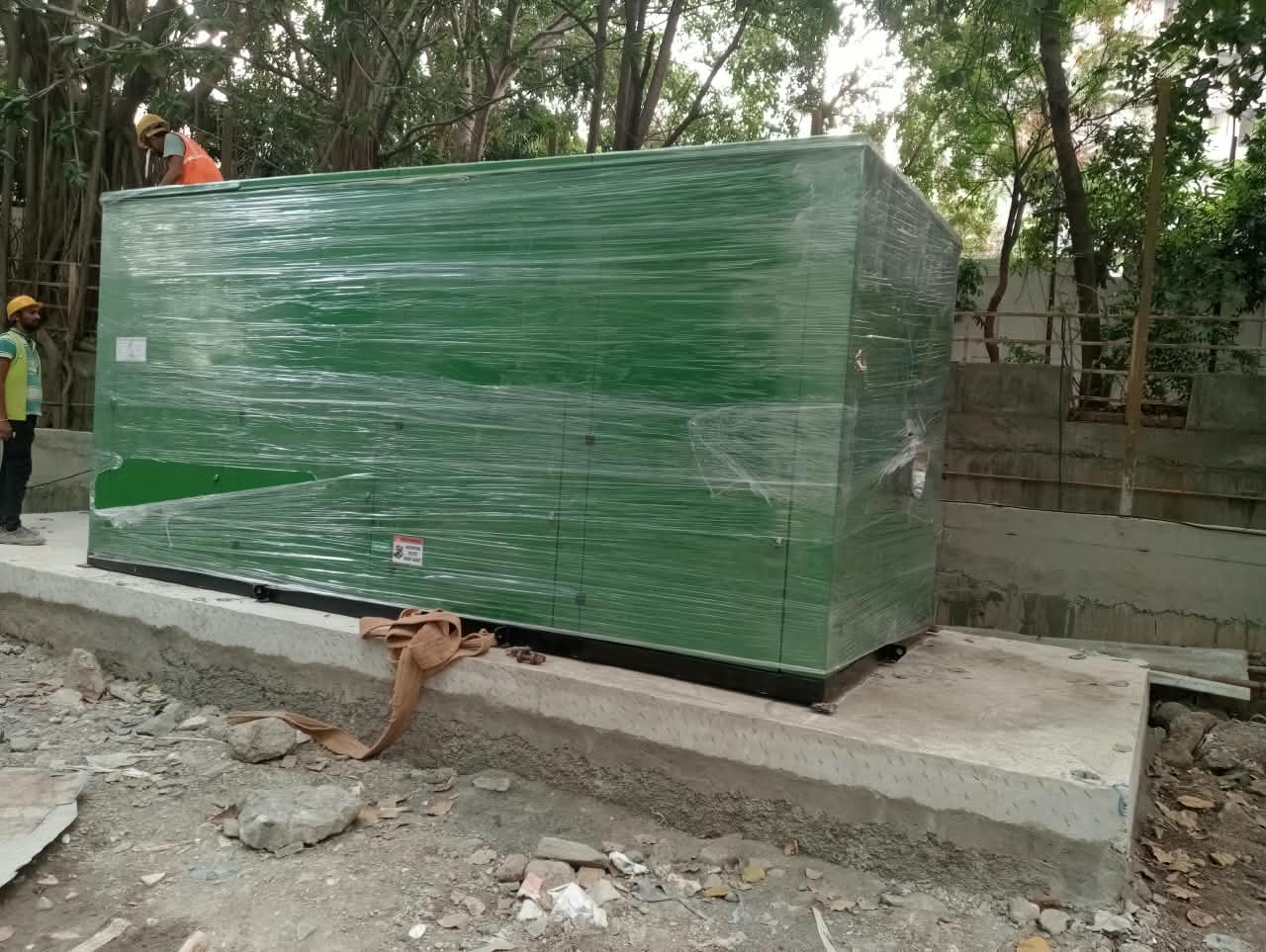
A modern heavy-duty In-Vessel Composting Machine installed by Green Planet Solutions in Pune — self-contained, odourless, and zero-crate footprint.
The 6 Critical Deciding Factors for Housing Societies
1. Turnaround Time & Rotten Waste Backlog
Traditional OWC: Requires a rolling 10–15 day inventory of rotting waste on society premises. A 300 kg/day society will have 3,000 to 4,500 kg of decomposing waste stored in crates at any given time. During monsoon humidity, curing stalls, causing severe overflow.
In-Vessel System: Operates on a strict 24-hour cycle. Waste loaded on Monday is dry, stabilized compost by Tuesday morning. The waste room starts fresh every day.
2. Real Space Footprint (The Hidden Crate Area)
Traditional OWC: While the machine itself is compact, vendors often hide the curing yard footprint. You need 400 to 600 sq. ft. of covered shed space with multi-tier racks to store 120–150 crates.
In-Vessel System: Total footprint is only 120 to 180 sq. ft. including operating clearance. No external curing racks or yard space needed.
3. Odour, Flies, and Resident Complaints
Traditional OWC: Open curing crates release volatile organic acids and attract fruit flies, maggots, and rodents right next to resident parking and balconies. This is the #1 reason OWCs get abandoned within 18 months.
In-Vessel System: 100% hermetically sealed. Thermophilic temperatures (>55°C) kill fly larvae and pathogens instantly, with filtered exhaust venting.
4. Daily Housekeeping Labour Demands
Traditional OWC: Requires 2 to 3 hours of strenuous manual work every day — shoveling, lifting 30 kg crates, watering, and rotating racks.
In-Vessel System: Takes 20 to 30 minutes daily. Housekeeping simply feeds the waste into the hopper and closes the hatch.
5. Recurring Consumables & Operating Cost (OpEx)
Traditional OWC: Recurring monthly cost of ₹8,000 to ₹15,000 for sawdust/cocopeat bags and bacterial culture powder.
In-Vessel System: Self-propagating thermophilic bacteria. Minimal to zero monthly chemical costs.

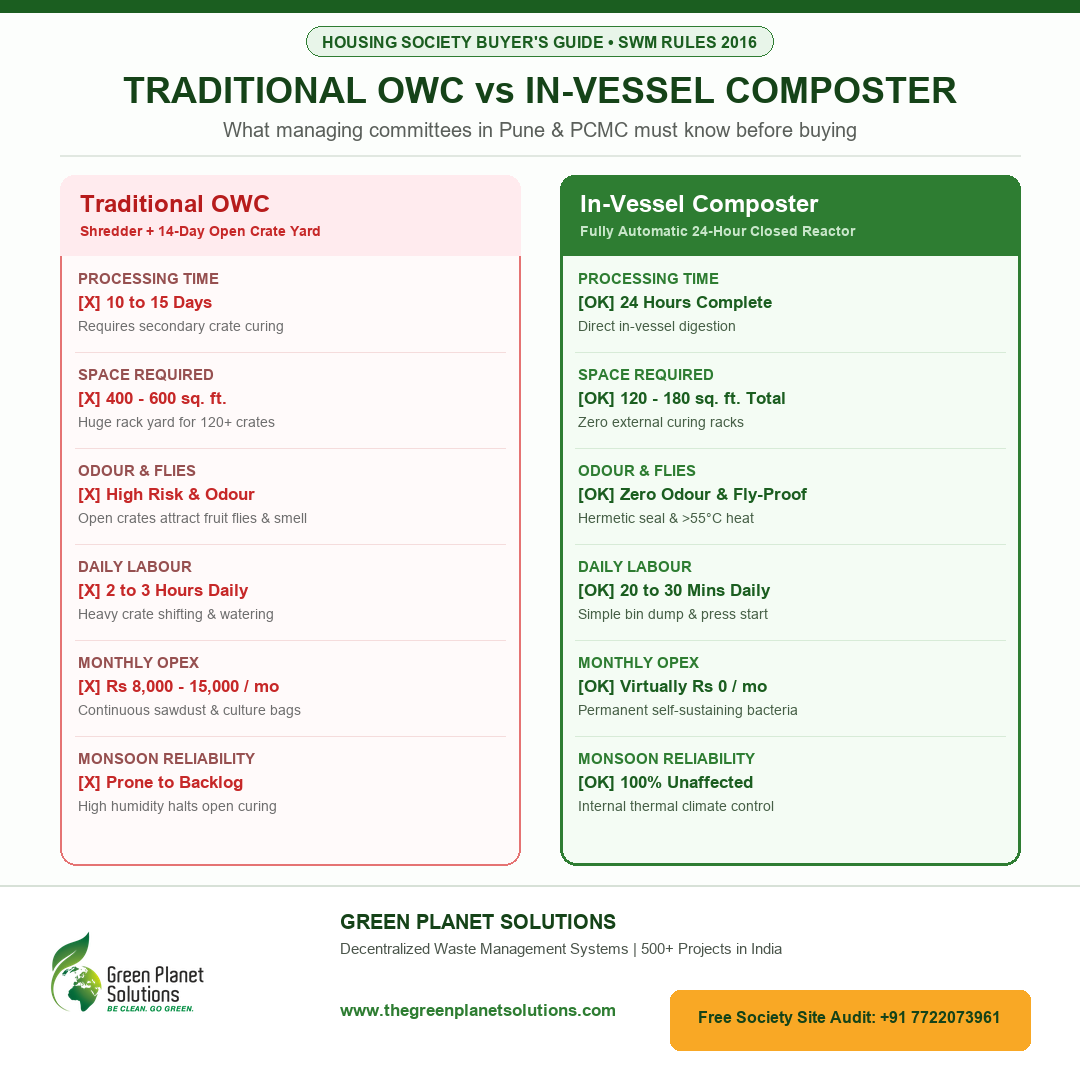
Summary infographic: Traditional OWC vs Modern Fully Automatic In-Vessel Composting Machine.
Quick Comparison Matrix for Committee Meetings
| Parameter | Traditional OWC | In-Vessel Composter |
|---|---|---|
| Processing Time | 10 to 15 Days (external racks) | 24 Hours (in-machine) |
| Space Required | 400 – 600 sq. ft. (curing racks) | 120 – 180 sq. ft. total |
| Odour & Fly Infestation | High risk during crate curing | Zero (Sealed & heated) |
| Daily Labour | 2 to 3 hrs daily crate shifting | 20 to 30 mins simple loading |
| Volume Reduction | 40% to 50% | 85% to 90% |
| Monsoon Vulnerability | High (Humidity stops curing) | None (Thermally controlled) |
Quick Sizing Rule for Pune Societies
Estimate approx. 0.6 kg to 0.8 kg of wet food waste per flat per day:
- 100 to 150 Flats: Generates ~80–120 kg/day → 100–125 kg/day In-Vessel Machine
- 250 to 350 Flats: Generates ~180–250 kg/day → 250 kg/day In-Vessel Machine
- 500 to 700 Flats: Generates ~350–500 kg/day → 500 kg/day In-Vessel Machine
- 1,000+ Flat Townships: Dual 500 kg or 1,000 kg Continuous System
Plan Your Society’s Composting Setup with Confidence
Get a free on-site waste load calculation, civil plinth drawing, and turnkey proposal from Green Planet Solutions.
Request Free Society Site Assessment →
Trusted across 500+ residential and commercial installations in Pune, PCMC, and pan-India.
Green Planet Solutions | Direct Helpline: +91 7722073961 | Email: info@thegreenplanetsolutions.com | Website: www.thegreenplanetsolutions.com

Leave a Reply