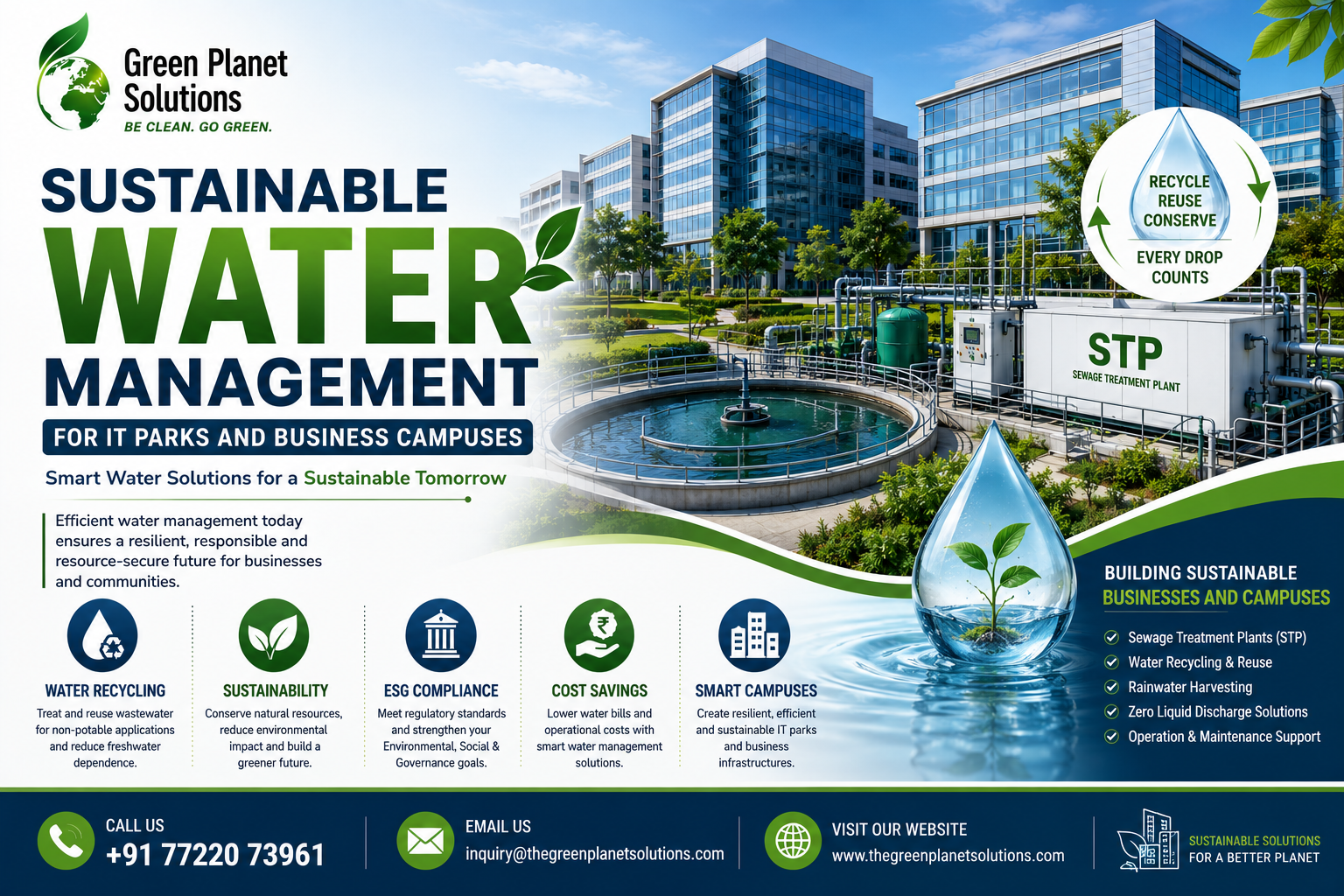
How Smart Water Solutions Help Commercial Campuses Reduce Costs, Conserve Resources, and Achieve Sustainability Goals
As businesses continue to expand and urban infrastructure grows, IT parks and business campuses consume enormous amounts of water every day. From office buildings and cafeterias to cooling towers, landscaping, and sanitation facilities, water plays a critical role in daily operations. However, increasing water scarcity, rising utility costs, and stricter environmental regulations have made sustainable water management a necessity rather than a choice.
Modern IT parks are now adopting intelligent water management solutions such as Sewage Treatment Plants (STPs), rainwater harvesting systems, water recycling technologies, and smart monitoring systems to reduce freshwater consumption while supporting long-term sustainability. These solutions not only conserve valuable water resources but also improve operational efficiency and strengthen corporate ESG commitments.
What Is Sustainable Water Management?
Sustainable water management is the process of using water responsibly while minimizing waste and maximizing reuse. It involves collecting, treating, recycling, and monitoring water to ensure that available resources are used efficiently without compromising future needs.
For IT parks and commercial campuses, sustainable water management focuses on reducing freshwater dependency through wastewater treatment, rainwater harvesting, and efficient water distribution systems.
Why IT Parks Need Sustainable Water Management
A typical business campus supports thousands of employees every day, resulting in high water consumption for drinking, sanitation, food preparation, cooling systems, landscaping, and maintenance activities.
Without proper water management, organizations often experience:
- Rising water bills
- Increased dependence on municipal water supply
- Frequent tanker water requirements
- Water shortages during peak summer months
- Higher environmental impact
- Difficulty meeting sustainability targets
Implementing a comprehensive water management strategy helps businesses overcome these challenges while ensuring uninterrupted operations.
The Role of Sewage Treatment Plants (STPs) of Water Management
A Sewage Treatment Plant (STP) is one of the most effective solutions for sustainable water management. It collects wastewater generated within the campus, removes contaminants, and converts it into treated water suitable for non-potable applications.
Instead of discharging wastewater into municipal drains, IT parks can recycle treated water for everyday operational needs, reducing dependence on freshwater resources.
Applications of Recycled Water
Water treated through an STP can be reused across multiple campus operations, including:
- Landscape irrigation
- Toilet flushing
- Cooling tower makeup water
- Floor and pavement cleaning
- Vehicle washing
- Construction activities
- Firewater storage replenishment
These applications help businesses significantly reduce freshwater consumption while maintaining operational efficiency.
Benefits of Sustainable Water Management
1. Reduced Water Costs
Recycling treated wastewater lowers the demand for municipal water and private water tankers. Over time, this results in substantial savings on monthly utility expenses.
2. Reliable Water Supply
Water shortages can disrupt daily business operations. By treating and reusing wastewater, organizations create an additional water source that improves water security throughout the year.
3. Environmental Protection
Wastewater treatment prevents untreated sewage from entering rivers, lakes, and groundwater sources. This reduces pollution while protecting local ecosystems and biodiversity.
4. Improved ESG Performance
Environmental, Social, and Governance (ESG) reporting has become increasingly important for businesses. Sustainable water management demonstrates responsible resource utilization, strengthens corporate sustainability initiatives, and enhances stakeholder confidence.
5. Regulatory Compliance
Many commercial developments are required to comply with environmental regulations related to wastewater treatment and water reuse. Installing an STP helps organizations meet these requirements while avoiding penalties and operational risks.
Rainwater Harvesting: A Valuable Addition
Rainwater harvesting complements wastewater recycling by collecting and storing rainwater for future use. During the monsoon season, harvested rainwater can be used for landscaping, groundwater recharge, and other non-potable purposes.
Combining rainwater harvesting with an STP creates a comprehensive water management system that maximizes resource efficiency.
Smart Water Monitoring Technologies
Modern IT parks are increasingly adopting digital technologies to improve water management.
Smart monitoring systems provide:
- Real-time water consumption data
- Leak detection alerts
- Water quality monitoring
- Automated reporting
- Equipment performance tracking
- Predictive maintenance insights
These technologies help facility managers optimize water usage while reducing operational costs.
Economic Benefits for Businesses
Investing in sustainable water management delivers long-term financial advantages.
Businesses can benefit from:
- Lower water procurement costs
- Reduced wastewater disposal expenses
- Lower maintenance costs
- Increased operational efficiency
- Improved return on investment
- Enhanced property value
These savings make sustainable infrastructure an economically sound investment.
Supporting Green Building Certifications
Sustainable water management also contributes to internationally recognized green building certifications such as LEED, IGBC, and GRIHA. Efficient wastewater treatment, water recycling, and rainwater harvesting earn valuable sustainability credits while improving the environmental performance of commercial buildings.
Green-certified campuses are more attractive to investors, tenants, and environmentally conscious clients.
Best Practices for Sustainable Water Management
To maximize water efficiency, IT parks and business campuses should:
- Install an efficient Sewage Treatment Plant (STP)
- Reuse treated wastewater wherever possible
- Implement rainwater harvesting systems
- Monitor water consumption regularly
- Repair leaks immediately
- Use water-efficient fixtures
- Conduct routine maintenance of treatment systems
- Train facility management teams on water conservation practices
Following these practices ensures long-term water security and operational efficiency.
The Future of Water Management
With growing concerns about climate change and water scarcity, businesses are increasingly investing in intelligent water management technologies. IoT-enabled sensors, AI-powered monitoring systems, automated treatment plants, and advanced recycling technologies are shaping the future of sustainable commercial infrastructure.
Organizations that adopt these solutions today will be better prepared to manage resources responsibly while reducing operating costs and strengthening environmental performance.
Conclusion
Sustainable water management is no longer just an environmental initiative—it is a strategic business investment. For IT parks and business campuses, implementing solutions such as Sewage Treatment Plants, water recycling systems, rainwater harvesting, and smart monitoring technologies ensures reliable water availability, reduces operational expenses, and supports long-term sustainability goals.
By treating wastewater as a valuable resource rather than a waste product, businesses can build resilient campuses that protect natural resources, enhance ESG performance, and create a healthier environment for employees and future generations.
Leave a Reply