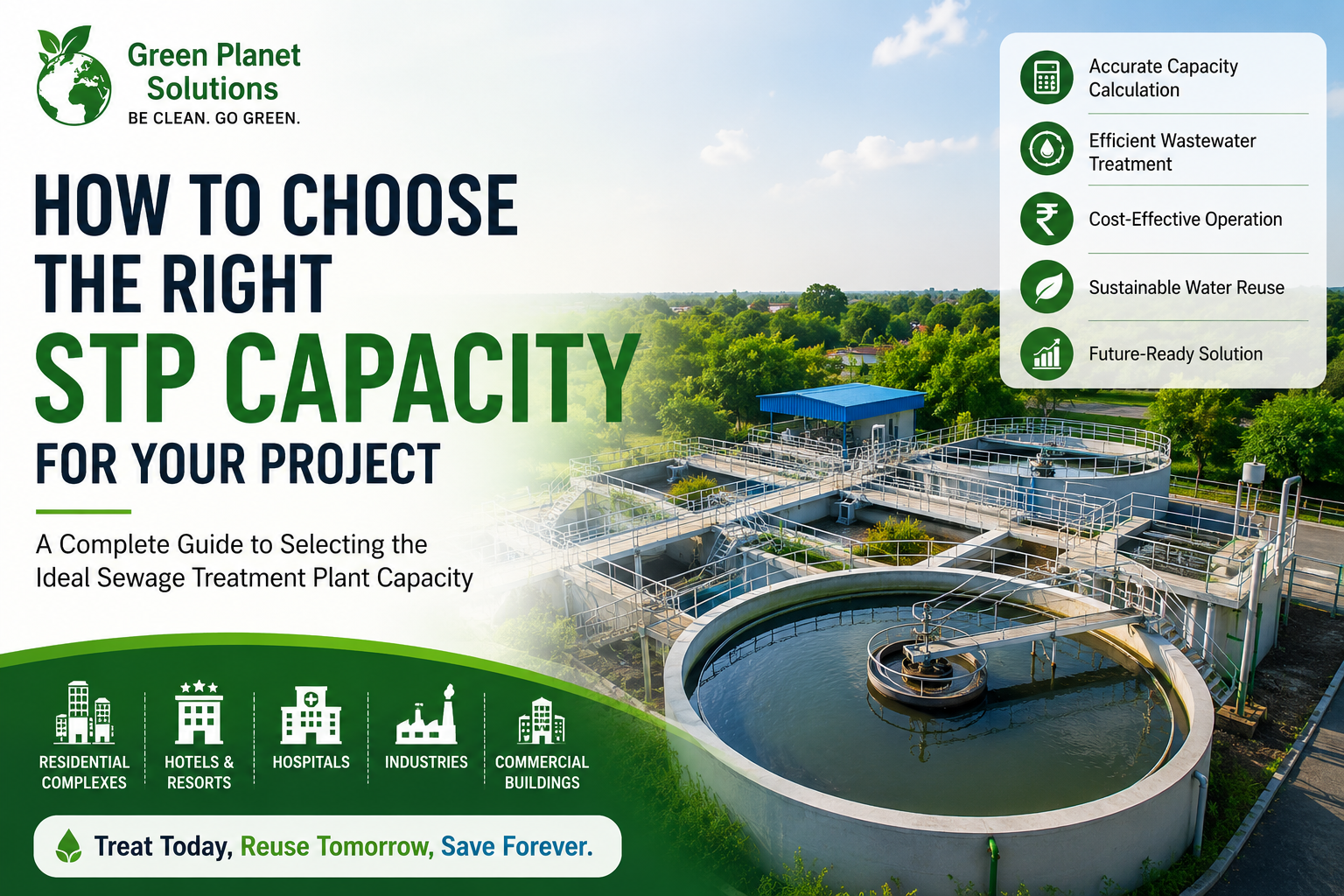
A Complete Guide to Selecting the Ideal Sewage Treatment Plant STP Capacity
Choosing the right Sewage Treatment Plant (STP) capacity is one of the most important decisions when planning a residential, commercial, or industrial project. An undersized STP can struggle to treat wastewater efficiently, leading to operational issues and regulatory non-compliance. On the other hand, an oversized system increases installation costs, energy consumption, and maintenance expenses. Selecting the correct STP capacity ensures efficient wastewater treatment, water reuse, long-term cost savings, and reliable performance. Understanding your project’s wastewater generation and future requirements is the key to making the right investment.
Why Choosing the Right STP Capacity Matters
Every building generates wastewater from daily activities such as cooking, bathing, washing, toilet use, and cleaning. The amount of wastewater varies depending on the number of occupants, the type of facility, and water consumption patterns.
A correctly sized STP helps:
- Treat wastewater efficiently
- Reduce operating and maintenance costs
- Ensure environmental compliance
- Improve water recycling
- Increase system lifespan
- Support future expansion
Proper capacity planning allows businesses and residential communities to achieve maximum return on investment while protecting the environment.
Understand Your Daily Wastewater Generation
The first step in selecting an STP is estimating the total amount of wastewater generated every day. In most projects, approximately 80–90% of the freshwater consumed becomes wastewater.
Factors affecting wastewater generation include:
- Number of residents or occupants
- Daily water consumption
- Type of building
- Commercial activities
- Industrial processes
- Seasonal usage variations
A detailed water consumption study provides the foundation for accurate STP sizing.
Identify Your Project Type OF STP
Different facilities generate different volumes and types of wastewater. Therefore, the required capacity depends largely on the nature of the project.
Common applications include:
- Residential Apartments
- Housing Societies
- Hotels and Resorts
- Hospitals
- Educational Institutions
- Shopping Malls
- Commercial Buildings
- Corporate Offices
- Food Processing Units
- Manufacturing Industries
Each sector has unique wastewater characteristics that influence the design and treatment capacity.
Calculate Future Demand
An STP is a long-term investment that should support future growth. If your project is expected to expand over the coming years, choose a system with additional capacity to accommodate increased wastewater generation.
Planning for future expansion helps avoid costly upgrades or complete system replacement later.
Evaluate Water Reuse Requirements
Many organizations install not only to treat wastewater but also to recycle water for non-potable applications.
Treated water can be reused for:
- Landscape irrigation
- Gardening
- Toilet flushing
- Cooling towers
- Floor cleaning
- Vehicle washing
Higher reuse requirements may influence the treatment process and overall plant capacity.
Consider Available Installation Space
Modern STPs are available in compact, modular, and customized designs. Before selecting a system, evaluate the available installation area.
Important considerations include:
- Plant footprint
- Access for maintenance
- Future expansion space
- Equipment accessibility
- Utility connections
Compact systems are ideal for projects where space is limited.
Choose the Right Treatment Technology
Different treatment technologies offer different efficiencies, operating costs, and space requirements.
Popular STP technologies include:
- MBBR (Moving Bed Biofilm Reactor): Compact, efficient, and low maintenance.
- MBR (Membrane Bioreactor): Produces high-quality treated water suitable for reuse.
- SBR (Sequential Batch Reactor): Flexible operation with excellent treatment performance.
- ASP (Activated Sludge Process): Suitable for large-scale wastewater treatment applications.
Selecting the appropriate technology ensures better treatment efficiency and long-term reliability.
Focus on Energy Efficiency
Energy costs significantly affect the long-term operating expenses of an STP. Modern energy-efficient systems use advanced blowers, pumps, automation, and process controls to minimize electricity consumption while maintaining excellent treatment performance.
Choosing an energy-efficient STP reduces operational costs throughout the plant’s lifespan.
Ensure Compliance with Environmental Regulations
Your STP should comply with applicable environmental regulations and wastewater discharge standards. A compliant system helps avoid legal issues while protecting natural water resources.
Working with an experienced STP manufacturer ensures your project meets all necessary environmental and operational requirements.
Choose a Reliable STP Manufacturer
The performance of an STP depends not only on its capacity but also on its design, build quality, and after-sales support.
Look for a manufacturer that offers:
- Customized system design
- High-quality components
- Automated operation
- Technical consultation
- Installation support
- Regular maintenance services
- Long-term customer assistance
A trusted supplier helps ensure reliable operation for many years.
Common Mistakes to Avoid
When selecting an STP, avoid these common errors:
- Underestimating wastewater generation
- Ignoring future expansion plans
- Choosing the lowest-cost option instead of the best value
- Overlooking maintenance requirements
- Selecting inappropriate treatment technology
- Failing to consider water reuse objectives
Avoiding these mistakes results in better performance and lower lifetime costs.
Benefits of Choosing the Correct STP Capacity
Selecting the right capacity provides several long-term advantages:
- Efficient wastewater treatment
- Lower operating expenses
- Reduced maintenance costs
- Better water recycling
- Compliance with environmental regulations
- Improved sustainability
- Longer equipment life
- Higher return on investment
Why Choose Green Planet Solutions?
At Green Planet Solutions, we design and supply customized Sewage Treatment Plants for residential apartments, commercial buildings, hotels, hospitals, industries, educational institutions, and housing societies. Our STP systems combine advanced treatment technologies, energy-efficient operation, and reliable performance to meet your project’s unique wastewater management needs.
Our experienced team helps you assess wastewater generation, select the right capacity, and deliver a solution that supports long-term sustainability and regulatory compliance.
Conclusion
Choosing the right STP capacity is essential for efficient wastewater treatment, cost-effective operation, and sustainable water management. By evaluating wastewater generation, project type, future expansion, water reuse requirements, available space, and treatment technology, you can select an STP that delivers reliable performance for years to come.
With the right planning and expert guidance from Green Planet Solutions, your project can achieve efficient wastewater treatment, conserve valuable water resources, and contribute to a cleaner, greener future.