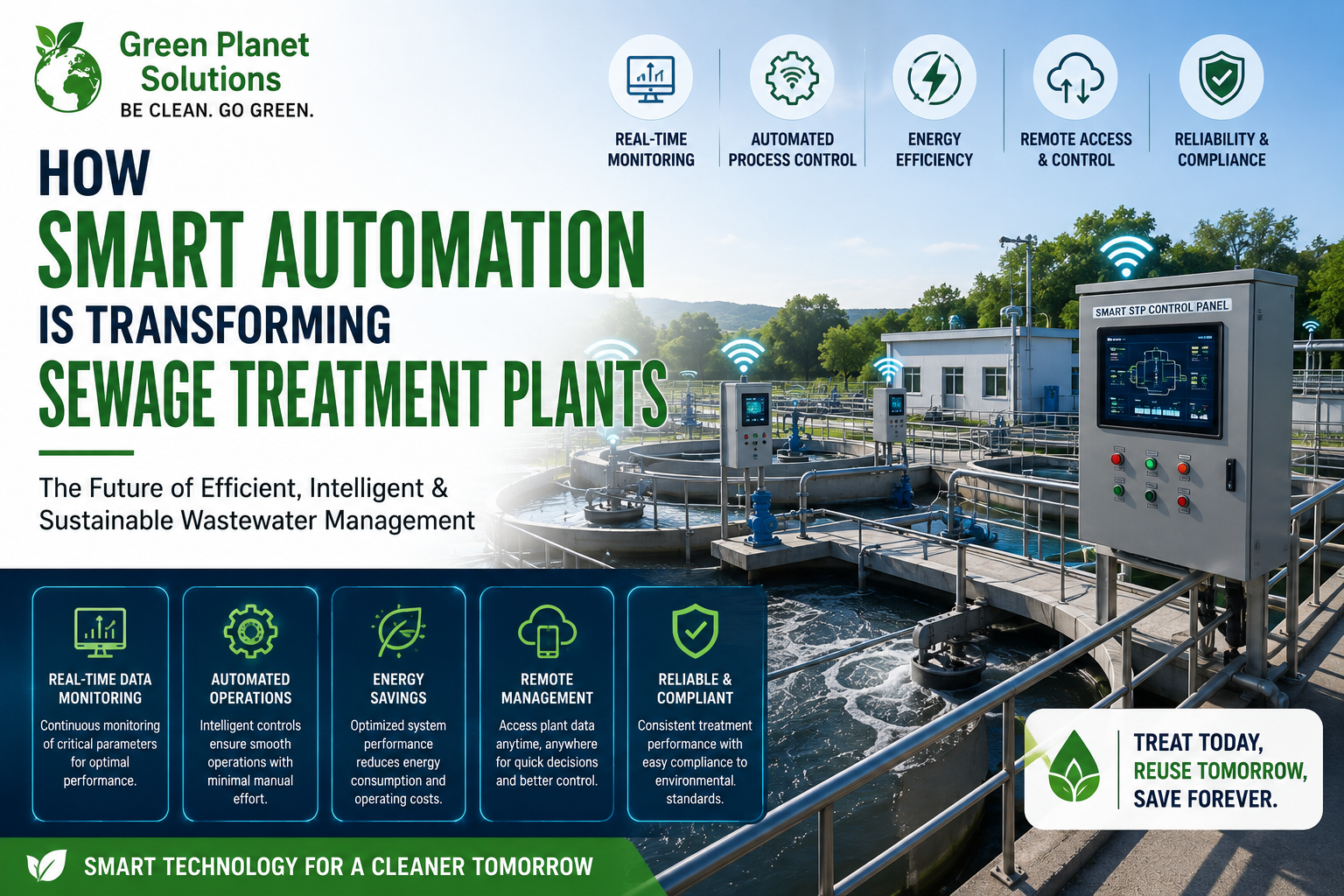
The Future of Efficient, Intelligent, and Smart Sustainable Wastewater Management
As industries, residential communities, and commercial facilities continue to expand, the demand for efficient wastewater treatment is growing rapidly. Traditional Sewage Treatment Plants (STPs) often require continuous manual monitoring, regular maintenance, and skilled operators to maintain optimal performance. Today, smart automation is transforming the way STPs operate by improving efficiency, reducing operating costs, enhancing water quality, and minimizing human intervention. With advanced sensors, intelligent control systems, and real-time monitoring, automated STPs are becoming the preferred choice for modern wastewater management.
What Is Smart Automation in an STP?
Smart automation refers to the integration of advanced technologies such as sensors, programmable logic controllers (PLCs), automated pumps, IoT devices, and digital monitoring systems into a Sewage Treatment Plant. These technologies work together to monitor, control, and optimize every stage of the wastewater treatment process with minimal manual effort.
Instead of relying solely on operators, automated systems continuously collect data, adjust operating parameters, and ensure the plant functions efficiently around the clock.
Why Smart Automation Is Becoming Essential
Wastewater treatment has become more complex due to increasing water demand, stricter environmental regulations, and the need for sustainable water reuse. Manual operations often result in inconsistent performance, higher energy consumption, and delayed responses to equipment failures.
Smart automation solves these challenges by enabling continuous monitoring, improving treatment accuracy, and reducing the risk of human error.
Real-Time Monitoring for Better Performance
One of the biggest advantages of automation is real-time monitoring. Modern STPs continuously track important operating parameters such as:
- Water flow rate
- pH levels
- Dissolved oxygen
- Sludge levels
- Tank water levels
- Pump performance
- Energy consumption
- Water quality
If any parameter moves outside the desired range, the system immediately alerts operators, allowing quick corrective action before small issues become major problems.
Automatic Process Control
Smart control systems automatically adjust equipment based on real-time operating conditions.
For example:
- Pumps start and stop automatically.
- Aeration systems adjust oxygen supply.
- Chemical dosing is optimized.
- Water levels remain balanced.
- Blowers operate only when required.
This improves treatment efficiency while reducing unnecessary power consumption.
Energy Efficiency and Cost Savings
Electricity is one of the largest operating expenses for an STP. Automated systems optimize equipment operation by running pumps, motors, and blowers only when necessary.
This results in:
- Lower electricity bills
- Reduced equipment wear
- Longer machine life
- Lower maintenance costs
- Higher operational efficiency
Over time, automation significantly reduces the total cost of ownership.
Remote Monitoring and Control
Modern STPs can be connected to cloud-based platforms that allow operators to monitor plant performance from anywhere using a smartphone, tablet, or computer.
Remote monitoring enables users to:
- Check system status
- Receive maintenance alerts
- View operating reports
- Monitor treated water quality
- Respond quickly to faults
- Improve maintenance planning
This flexibility is especially valuable for organizations managing multiple facilities.
Predictive Maintenance
Instead of waiting for equipment to fail, automated STPs use operational data to predict maintenance needs.
The system identifies early signs of wear in components such as:
- Pumps
- Motors
- Blowers
- Valves
- Sensors
- Filters
Predictive maintenance reduces unexpected breakdowns, minimizes downtime, and extends equipment life.
Improved Water Quality
Consistent treatment conditions produce consistently high-quality treated water. Automation ensures that every treatment stage operates within the desired parameters, improving the removal of contaminants and pathogens.
High-quality treated water can safely be reused for:
- Gardening
- Landscape irrigation
- Toilet flushing
- Cooling towers
- Industrial processes
- Cleaning applications
This supports water conservation and sustainable resource management.
Supports Environmental Compliance
Environmental regulations require STPs to maintain strict discharge standards. Automated monitoring systems continuously record operational data and help ensure compliance with pollution control requirements.
Digital records also simplify reporting during inspections and environmental audits.
Applications of Smart Automated STPs
Automated sewage treatment systems are widely used across multiple sectors, including:
- Residential Apartments
- Housing Societies
- Hotels and Resorts
- Hospitals
- Educational Institutions
- Shopping Malls
- Corporate Offices
- Manufacturing Industries
- Industrial Parks
- Municipal Projects
These sectors benefit from reliable wastewater treatment with minimal manual supervision.
Key Benefits of Smart Automation
Businesses choosing automated STPs enjoy several long-term advantages:
- Real-time performance monitoring
- Lower operating costs
- Reduced energy consumption
- Better treatment efficiency
- Consistent water quality
- Faster fault detection
- Predictive maintenance
- Improved equipment lifespan
- Remote access and control
- Easier environmental compliance
These benefits make automation a valuable investment for both new and existing wastewater treatment facilities.
Why Choose Green Planet Solutions?
At Green Planet Solutions, we provide advanced Sewage Treatment Plants equipped with intelligent automation technologies designed for maximum efficiency and reliability. Our customized STP solutions combine high-performance treatment processes, energy-efficient equipment, and smart monitoring systems to deliver sustainable wastewater management for residential, commercial, and industrial applications.
Our experienced team supports customers from system design and installation to maintenance and long-term technical assistance, ensuring reliable performance throughout the plant’s lifecycle.
Conclusion
Smart automation is revolutionizing sewage treatment by making STPs more efficient, reliable, and environmentally sustainable. Through real-time monitoring, intelligent process control, predictive maintenance, and remote operation, automated systems help organizations reduce costs, improve water quality, and meet environmental regulations with ease.
By investing in an automated Sewage Treatment Plant from Green Planet Solutions, businesses and communities can embrace modern wastewater management while conserving water resources and contributing to a cleaner, greener future.