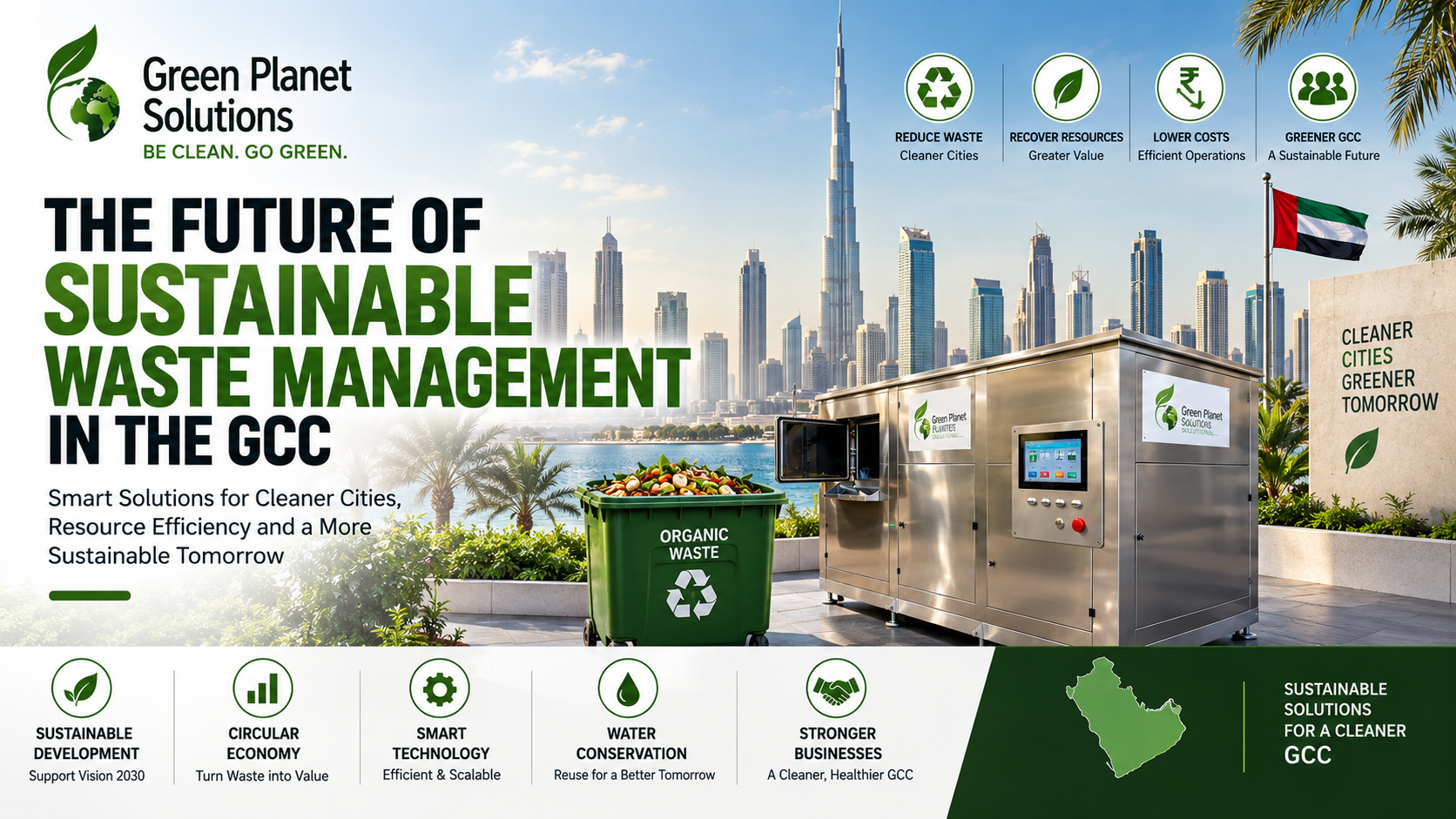
How Innovation, Circular Economy Practices, and Smart Technologies Are Shaping a Cleaner Future for the Gulf Region
The Gulf Cooperation Council (GCC) region is experiencing rapid urban development, population growth, tourism expansion, and infrastructure investment. Along with this growth comes an increasing amount of municipal, commercial, food, and organic waste.
For years, traditional waste disposal has been a common approach, but the region is gradually moving toward smarter and more sustainable waste management. Governments and businesses across the GCC are increasingly focusing on waste reduction, recycling, resource recovery, composting, wastewater treatment, and circular economy practices.
The future of waste management in the GCC will not simply be about disposing of waste—it will be about turning waste into valuable resources.
Why Sustainable Waste Management Matters in the GCC
The GCC has some of the world’s fastest-growing cities and highly developed commercial and hospitality sectors. Hotels, restaurants, shopping malls, residential communities, airports, hospitals, and large infrastructure projects generate significant quantities of waste every day.
At the same time, the region faces challenges such as limited natural resources, water scarcity, and the need to reduce environmental impact.
This makes efficient waste management an important part of sustainable development.
Moving from Waste Disposal to Resource Recovery
The traditional approach to waste management is often based on collecting waste and transporting it to a disposal facility.
The future is different.
Businesses are increasingly looking at ways to reduce waste at its source, segregate materials, recycle recoverable resources, and process organic waste.
Food waste, for example, can be processed through commercial composting systems instead of being sent directly to landfill. This creates a more circular approach to waste management and helps businesses make better use of their resources.
The Growing Role of Commercial Composting
Food waste is an important part of the waste generated by hotels, restaurants, food courts, catering companies, and commercial kitchens.
Commercial composting machines provide businesses with an opportunity to process suitable organic waste closer to where it is generated.
Instead of transporting large quantities of food waste for disposal, businesses can use an appropriately sized composting system to process organic material on-site.
This approach can help reduce waste transportation requirements, improve waste handling, and support sustainability objectives.
Smart Technology Will Transform Waste Management
Technology will play a major role in the future of waste management across the GCC.
Modern systems can incorporate automation, sensors, monitoring platforms, and data-based controls to improve operational efficiency.
Smart waste management can help organizations understand how much waste they generate, identify patterns, optimize collection schedules, and monitor the performance of waste-processing equipment.
For large facilities and smart-city developments, data-driven waste management can become an important part of efficient infrastructure.
Sustainable Waste Management for Hotels and Tourism
The hospitality and tourism sectors are major contributors to economic growth across the GCC. Hotels and resorts also generate considerable amounts of food and general waste.
As sustainable tourism becomes increasingly important, hotels are looking for practical solutions to reduce their environmental footprint.
On-site organic waste processing, recycling, waste segregation, and responsible wastewater treatment can help hotels build more sustainable operations while demonstrating their environmental commitment to guests.
Shopping Malls and Food Courts Need Smarter Solutions
Shopping malls and food courts generate organic waste throughout the day from restaurants, cafés, supermarkets, and food outlets.
Managing this waste efficiently can be challenging because of the volume and frequency of generation.
Commercial composting machines can provide an on-site solution for suitable organic waste, helping facilities reduce the amount of biodegradable material that requires external disposal.
Cleaner waste handling areas can also contribute to better hygiene and a more pleasant environment for customers and staff.
Water and Wastewater Management Will Go Hand in Hand
Waste management is only one part of the sustainability challenge facing the GCC. Water conservation is equally important.
With limited freshwater resources, efficient wastewater treatment and water reuse will become increasingly valuable.
Sewage Treatment Plants (STPs) can treat wastewater generated by residential communities, hotels, hospitals, commercial buildings, and industrial facilities. Depending on the treatment quality and applicable regulations, treated water can potentially be reused for applications such as landscaping, gardening, flushing, and certain industrial processes.
This reduces dependence on freshwater and supports a more circular approach to water management.
Circular Economy Will Become More Important
The circular economy focuses on keeping resources in use for as long as possible rather than following a simple take, use, and dispose model.
In waste management, this can mean:
- Reducing waste generation
- Reusing materials
- Recycling recoverable resources
- Composting organic waste
- Recovering valuable materials
- Reusing treated wastewater
For GCC businesses, adopting circular practices can improve resource efficiency while supporting long-term sustainability goals.
Businesses Will Focus More on ESG
Environmental, Social, and Governance (ESG) considerations are becoming increasingly relevant to businesses and investors.
Waste reduction, recycling, composting, water conservation, and responsible wastewater treatment can all contribute to an organization’s environmental objectives.
As sustainability becomes more closely connected with business performance, companies that implement measurable waste management initiatives can strengthen their environmental credentials and demonstrate responsible operations.
Sustainable Infrastructure Will Become a Competitive Advantage
For new hotels, residential communities, commercial developments, and industrial projects, waste management is increasingly being considered during the planning stage rather than after construction.
Developers can integrate:
- Organic waste processing
- Recycling areas
- Waste segregation systems
- Sewage treatment plants
- Treated-water reuse
- Smart monitoring
- Energy-efficient equipment
Planning these systems early can create more efficient infrastructure and reduce the need for expensive modifications later.
The Role of Businesses in the GCC’s Green Future
Government initiatives can create the framework for sustainable development, but businesses also have an important role to play.
Organizations can begin by measuring their waste generation, improving segregation, reducing unnecessary waste, and investing in appropriate treatment and recovery technologies.
Even a single hotel, restaurant, mall, or residential community can make a meaningful difference by changing how it manages organic waste and wastewater.
When these practices are adopted across thousands of facilities, the overall impact can be significant.
What the Future Could Look Like
The future GCC waste management ecosystem is likely to become more:
Automated
Less manual intervention and more intelligent equipment.
Data-Driven
Real-time information can help businesses make better operational decisions.
Circular
Waste will increasingly be viewed as a potential resource rather than simply something to discard.
Decentralized
More businesses and developments may process organic waste and wastewater closer to the point of generation.
Resource-Efficient
Greater emphasis will be placed on reducing freshwater consumption, energy use, and waste transportation.
Sustainability-Focused
Environmental performance will increasingly become part of business strategy and infrastructure planning.
Why Green Planet Solutions?
Green Planet Solutions provides sustainable waste and wastewater management solutions for commercial, residential, hospitality, industrial, and institutional applications.
Our solutions include commercial composting machines and Sewage Treatment Plants (STPs) designed to help organizations manage organic waste and wastewater more efficiently.
By combining practical technology with sustainable waste management practices, we help businesses reduce waste, conserve resources, and take meaningful steps toward a cleaner future.
Planning sustainable waste or wastewater infrastructure for a GCC project? Share your waste stream, required capacity, site location, and project requirements with Green Planet Solutions at +91 7722073961 or inquiry@thegreenplanetsolutions.com.
Conclusion
The future of sustainable waste management in the GCC is moving toward resource recovery, smart technology, automation, water reuse, and circular economy practices.
As cities grow and sustainability becomes increasingly important, businesses will need to rethink how they manage the waste and wastewater they generate. Commercial composting, recycling, advanced STPs, and smart monitoring systems can all contribute to this transition.
The opportunity is clear: instead of viewing waste as a problem, the GCC can increasingly treat it as a resource with value.
The Future Is Sustainable. The Future Is Smart.
With the right technology and responsible practices, GCC businesses can reduce waste, conserve resources, improve efficiency, and contribute to a cleaner, greener, and more sustainable Middle East.