Table Of Contents
- Introduction
- How to Use Your Semi Automatic Drum Composter
- 1. Collect and Sort Your Waste
- 2. Shred Large Scraps
- 3. Load the Drum
- 4. Add “Brown” Material
- 5. Rotate the Drum
- 6. Let it Cook
- Frequently Asked Questions (FAQs)
- Conclusion
Introduction
Have you ever thought about where vegetable peels, leftover food, etc., go when you throw them out? Nine out of ten times, it goes to huge smelly landfills, etc. What would happen, though, if that waste could become “black gold” in your garden? Using a Semi Automatic Drum composter would not only help your society in a cost-effective way, it would do so in a simple way that will do good for our planet.
Managing the Semi Automatic Drum Composter is far easier when compared to the traditional pit method of composing, as the machine will take care of the mixing part. It is space-saving too, ideal for buildings that have 10 to 30 flats. If you just follow the simple steps given here, the garbage will be turned to treasure in no time.
How to Use Your Semi Automatic Drum Composter
1. Collect and Sort Your Waste
First, you have to ensure that only the proper stuff goes in there. You should only use “wet waste” such as fruit skins, vegetable peels, coffee grounds, etc., while plastic, metal, or glass should never go in there, as they would destroy your electronics as a consequence.
2. Shred Large Scraps
If you have big pieces, like a whole watermelon rind or thick cabbage leaves, it’s a good idea to chop them into smaller bits. This gives the “good bacteria” more surface area to eat, which makes the composting happen much faster.
3. Load the Drum
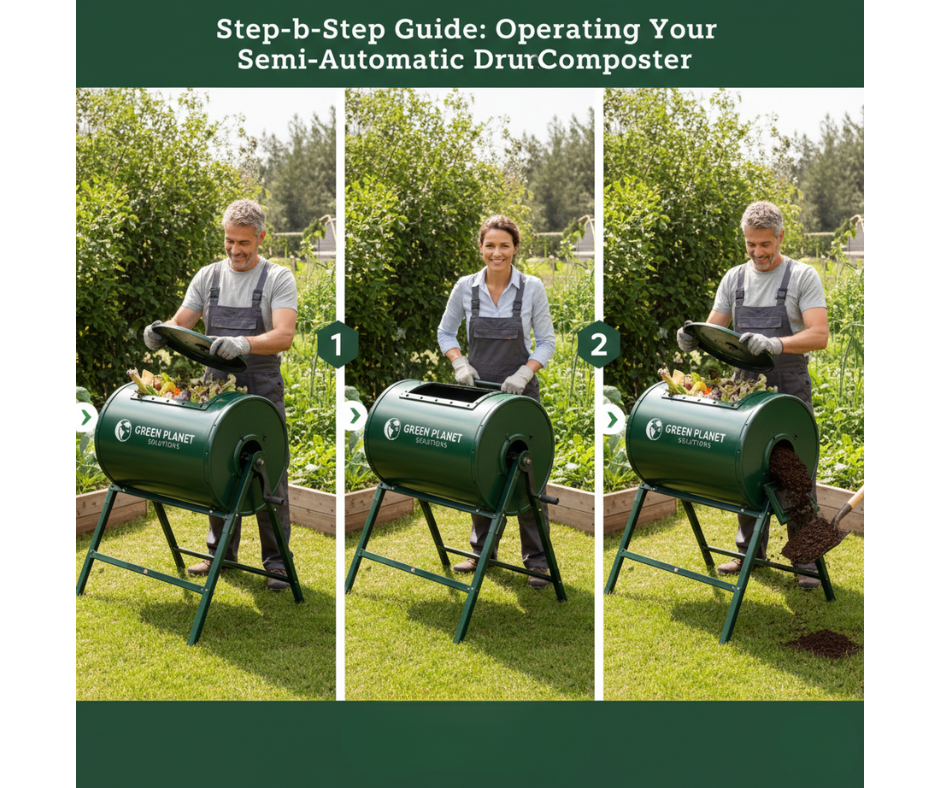
Open the lid of your Semi Automatic Drum Composter and pour in your sorted wet waste. Try to do this at the same time every day so the machine stays on a regular schedule.
4. Add “Brown” Material
To keep the compost from getting too soggy or smelly, add some dry leaves, sawdust, or shredded cardboard. This adds carbon, which balances out the nitrogen in the food scraps.
5. Rotate the Drum
This is the “Semi Automatic” part! Instead of using a shovel to turn a heavy pile, you simply use the handle or the motor to rotate the drum. This mixes in fresh air (oxygen), which helps the microbes breathe and prevents bad odors.
6. Let it Cook
The inside of the drum will naturally get warm as the waste breaks down. After the drum is full, let it sit and rotate it occasionally for a few weeks until the waste turns into dark, crumbly soil that smells like fresh earth.
Frequently Asked Questions (FAQs)
Q: Does it consume much electricity?
No, as it is built to consume minimal amounts of electricity to simply rotate its drum; hence your society won’t incur large electricity bills.
Q: Does it attract Flies/Rats?
Since the drum is sealed, the waste is rotated, and therefore, the drum remains hygienic, free from flies/ rats like an open-pit method.
Q: How often do we need to rotate it?
Normally, every day or every other day for a few minutes should do the trick in moving the air and keeping things composting nicely.
Conclusion
“Assisting the Earth does not have to be a challenging task.” If one abides by these easy measures, anyone in your society is able to utilize the Semi Automatic Drum Composter. It is a clean, cost-effective, and smart way to be sure that our waste does not harm the Earth, but instead helps the Earth.