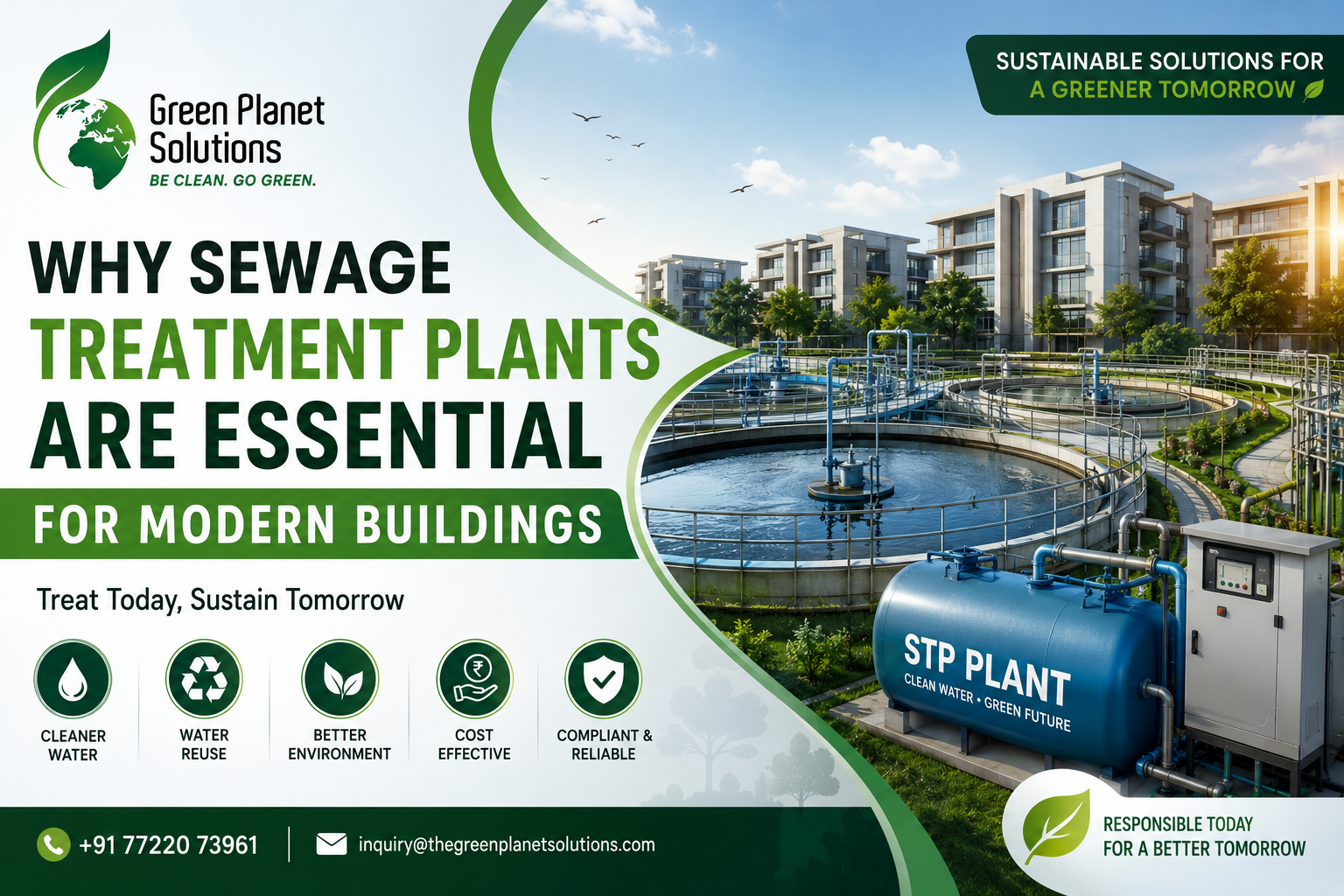
Turning Wastewater into a Sustainable Resource
Modern buildings are designed to provide comfort, convenience, and efficiency. From residential societies and hotels to hospitals, offices, and commercial complexes, these buildings consume a significant amount of water every day. But with high water consumption comes another challenge—large volumes of wastewater.Simply sending this wastewater into drains is no longer a sustainable solution. An efficient Sewage Treatment Plant (STP) helps buildings treat wastewater before it is discharged or reused. It not only supports better wastewater management but also helps businesses and communities move toward a more sustainable future.
What Is a Sewage Treatment Plant (STP)?
A Sewage Treatment Plant is a system designed to treat wastewater generated from toilets, bathrooms, kitchens, laundry areas, and other domestic activities. The treatment process removes organic matter, suspended solids, and other pollutants from sewage.
Depending on the technology and project requirements, an STP can use processes such as biological treatment, clarification, filtration, and disinfection to produce treated water suitable for permitted reuse applications.
Why Do Modern Buildings Need an STP?
As cities become more populated and buildings become larger, wastewater generation continues to increase. Managing this wastewater responsibly has become an important part of building operations.
An STP provides a structured solution by treating wastewater close to where it is generated. Instead of treating sewage as waste, modern wastewater management looks at it as a resource that can potentially be recovered and reused.
1. Helps Reduce Water Pollution
Untreated sewage can contain organic matter, suspended solids, nutrients, and harmful microorganisms. If it enters rivers, lakes, groundwater, or other water bodies without adequate treatment, it can negatively affect the surrounding environment.
An STP helps reduce the pollutant load before wastewater is discharged or reused, supporting cleaner surroundings and responsible water management.
2. Supports Water Reuse of (STP)
One of the biggest advantages of wastewater treatment is the possibility of water reuse.
Depending on the quality of treatment and applicable regulations, properly treated wastewater can be used for applications such as landscaping, gardening, toilet flushing, cleaning, and other non-potable purposes.
For large buildings, this can reduce dependence on fresh water for applications that do not require drinking-quality water.
3. Helps Buildings Manage Increasing Water Demand
Residential societies, hotels, hospitals, and commercial buildings can generate substantial quantities of wastewater every day.
Instead of relying entirely on external wastewater infrastructure, an appropriately designed STP provides an on-site treatment solution. This can make wastewater management more organized and efficient.
4. Supports Sustainable Building Operations of (STP)
Sustainability is becoming an important consideration in modern construction and facility management.
Water conservation, wastewater treatment, and water reuse can all contribute to a building’s overall environmental performance. An efficient STP can therefore become an important component of a building’s sustainability strategy.
5. Improves Hygiene and Environmental Management
Poorly managed sewage can create unpleasant odors, unhygienic surroundings, and environmental concerns.
A properly designed and maintained STP helps control wastewater within the building premises and supports better overall sanitation and environmental management.
6. Can Reduce Freshwater Consumption
Water reuse can help reduce the amount of fresh water required for certain building operations.
For example, if treated wastewater is suitable for landscaping or toilet flushing, buildings can use less fresh water for these purposes. Over time, this approach can contribute to more efficient water management.
7. Suitable for Different Types of Buildings
STPs can be designed according to the wastewater generation, available space, treatment requirements, and operational needs of a project.
They can be used in:
- 🏢 Commercial buildings
- 🏘️ Residential societies
- 🏨 Hotels and resorts
- 🏥 Hospitals
- 🏭 Industries and factories
- 🏫 Schools and educational institutions
- 🏬 Shopping and business complexes
The right STP design depends on factors such as daily sewage flow, wastewater characteristics, treated-water requirements, available space, and local regulations.
Choosing the Right STP for Your Building
Installing an STP is not simply about purchasing a treatment system. The plant needs to be properly designed for the building’s actual requirements.
Before selecting an STP, consider:
Daily wastewater generation: Estimate the actual sewage flow and future requirements.
Treatment quality: Define the quality of treated water required for discharge or reuse.
Available space: Consider whether the building requires a compact or conventional treatment solution.
Operation and maintenance: Choose a system that can be operated and maintained effectively.
Water reuse requirements: Identify where treated water could potentially be reused.
Regulatory requirements: Ensure the treatment system and treated-water quality meet applicable local requirements.
The Future of Wastewater Management
The future of building management is not only about consuming less water—it is also about using water more intelligently.
With growing urban populations, increasing water demand, and greater focus on environmental sustainability, wastewater treatment will continue to become an important part of modern infrastructure.
A well-designed STP can help transform wastewater from a disposal challenge into a potential resource for responsible reuse.
Green Planet Solutions – Building a Cleaner Water Future
At Green Planet Solutions, we focus on providing wastewater treatment solutions designed around the needs of modern projects. Our STP solutions are intended to help residential, commercial, hospitality, institutional, and industrial facilities manage sewage more efficiently and support water sustainability.
Treat wastewater today. Build a cleaner tomorrow.
📞 +91 77220 73961
📧 inquiry@thegreenplanetsolutions.com
Conclusion
Sewage Treatment Plants are becoming an essential part of modern buildings because they address one of the most important challenges of urban development—responsible wastewater management.
From reducing pollution and supporting water reuse to improving sanitation and contributing to sustainable building operations, an STP can provide both environmental and operational value.
Modern buildings need modern water management—and effective sewage treatment is an important step toward a cleaner, greener future.