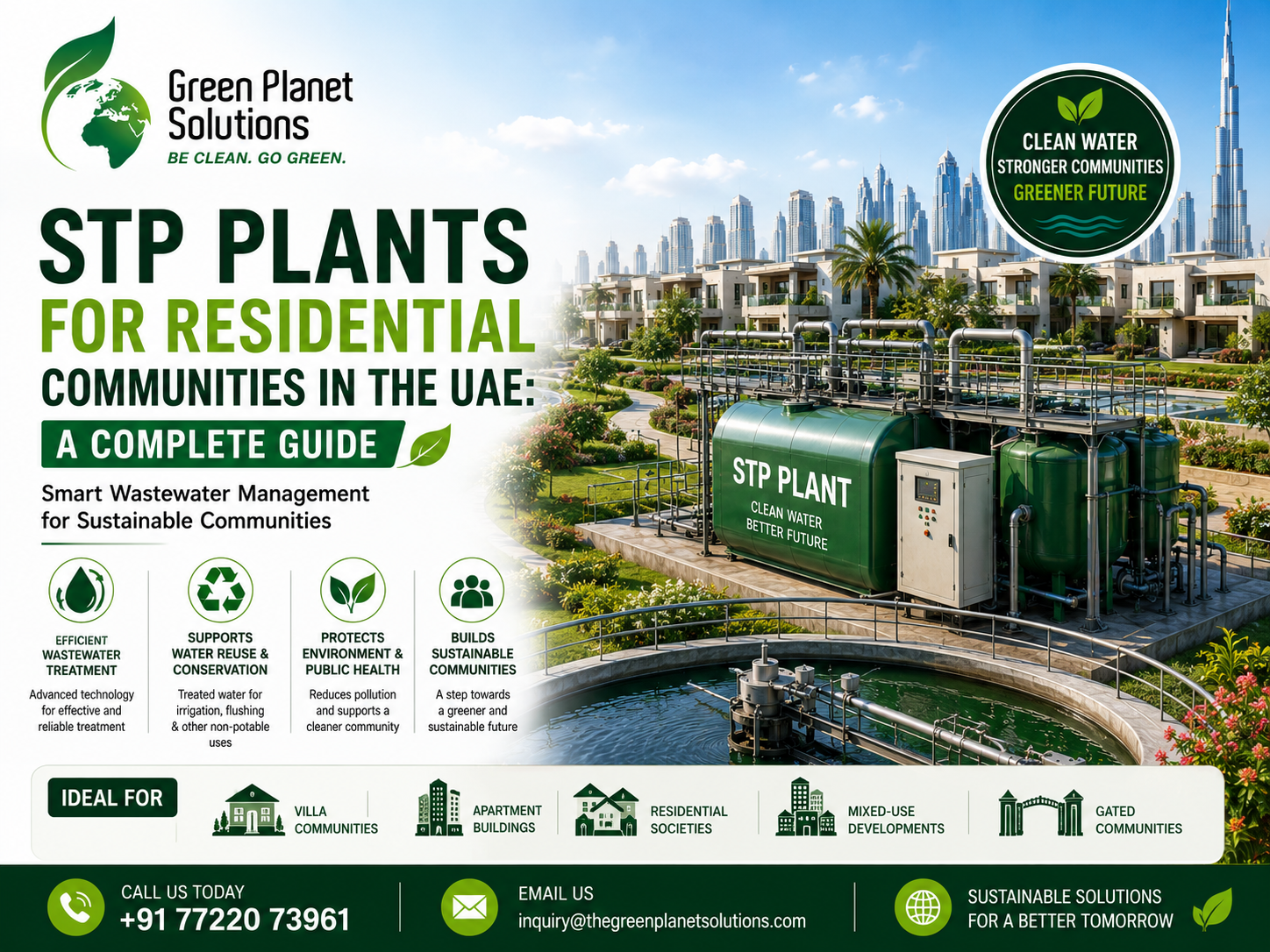
Smart Wastewater Management for Sustainable Residential Communities
The UAE is known for its rapid urban development, modern residential communities, and large-scale infrastructure projects. As residential buildings and communities continue to grow, so does the amount of wastewater generated every day. Managing this wastewater efficiently is becoming an important part of creating clean, sustainable, and well-planned communities. A Sewage Treatment Plant (STP) provides an effective way to treat wastewater generated from residential buildings before it is discharged or considered for suitable reuse. For residential communities in the UAE, a properly designed STP can support better water management, environmental protection, and long-term sustainability.
What Is an STP Plant?
A Sewage Treatment Plant is a wastewater treatment system designed to remove contaminants and pollutants from sewage generated by residential and other buildings.
Wastewater from bathrooms, toilets, kitchens, laundry areas, and other domestic activities is collected and transferred to the STP. Through different physical, biological, and treatment processes, unwanted contaminants are reduced and the wastewater is converted into treated water that can be managed according to the required quality and applicable regulations.
The exact treatment process depends on the project size, wastewater characteristics, required treated-water quality, available space, and intended reuse or discharge application.
Why Do UAE Residential Communities Need STP Plants?
Residential communities can generate significant quantities of wastewater every day. Large apartment complexes, gated communities, villas, and mixed-use developments may have hundreds or even thousands of residents using water regularly.
With water sustainability becoming increasingly important in the UAE, simply treating wastewater as waste is not an ideal long-term approach. A modern STP allows residential communities to manage wastewater systematically while creating opportunities for responsible water reuse.
1. Helps Manage Large Volumes of Wastewater USING STP
A residential community needs a reliable system to collect and treat the wastewater generated by its residents.
An appropriately sized STP can be designed according to the estimated wastewater flow of the community. This helps ensure that wastewater treatment capacity matches the requirements of the development, including potential future expansion.
Proper capacity planning is particularly important for large residential projects where wastewater generation can vary throughout the day.
2. Supports Water Reuse
Water is a valuable resource, particularly in regions where freshwater resources are limited.
After appropriate treatment and subject to applicable quality requirements, treated wastewater may be suitable for certain non-potable applications, such as landscape irrigation, toilet flushing, or other approved uses.
For residential communities, responsible reuse can help reduce the demand for fresh water in applications where drinking-quality water is not necessary.
3. Helps Protect the Environment
Poorly managed wastewater can create environmental and hygiene concerns.
An effective STP helps reduce pollutants and contaminants in sewage before the treated water is discharged or reused. This supports cleaner surroundings and more responsible wastewater management.
For large residential developments, this can be an important part of the community’s overall environmental strategy.
4. Supports Sustainable Residential Development
Modern residential projects are increasingly designed with sustainability in mind.
Energy efficiency, waste management, landscaping, water conservation, and wastewater treatment can all contribute to a more sustainable community.
An STP can become an important part of this approach by helping residential developments manage their wastewater while exploring opportunities for treated-water reuse.
5. Suitable for Different Residential Projects
STP systems can be designed for a wide range of residential developments.
They can be suitable for:
- 🏢 Apartment buildings
- 🏘️ Residential societies
- 🏡 Villa communities
- 🌆 Large residential developments
- 🏗️ New housing projects
- 🏨 Mixed-use residential developments
The treatment technology and plant capacity should be selected according to the specific requirements of each project rather than using a one-size-fits-all approach.
How Does an STP Work?
Although treatment technologies can vary, a typical sewage treatment process involves several stages.
1. Preliminary Treatment
Incoming sewage first passes through screening and other preliminary processes to remove larger solids and unwanted materials.
2. Primary Treatment
The wastewater is then processed to separate suspended solids and other settleable materials.
3. Biological Treatment
Microorganisms play an important role in breaking down biodegradable organic matter present in wastewater. This is one of the key stages of modern sewage treatment.
4. Secondary Clarification
The treated wastewater is separated from biological solids through clarification processes.
5. Filtration and Disinfection
Additional treatment may be provided depending on the required water quality. Filtration and disinfection can help improve the quality of treated water for its intended application.
6. Treated Water Management
The final treated water can then be discharged or considered for approved reuse applications, depending on its quality and applicable requirements.
How to Choose the Right STP for a Residential Community
Selecting an STP requires more than simply comparing equipment prices. The system should be designed around the actual needs of the residential development.
Consider Wastewater Flow
The first step is estimating how much wastewater the community will generate every day. Occupancy, number of apartments or villas, water consumption, and future expansion should all be considered.
Consider Available Space
Residential projects often have limited space for utility infrastructure. A compact treatment solution may therefore be useful where space is restricted.
Consider Treated Water Requirements
The required quality of treated water should be clearly defined before selecting the treatment technology, especially if the community plans to reuse treated water.
Consider Operation and Maintenance
An STP needs regular monitoring, maintenance, cleaning, and proper operation. A system that is easy to operate and maintain can help improve long-term reliability.
Consider Future Expansion
Residential communities can grow over time. Planning for potential increases in wastewater generation can help prevent capacity issues in the future.
STP Technology for UAE Residential Projects
Different treatment technologies can be considered depending on the project’s requirements. Technologies such as MBBR, SBR, MBR, and other biological treatment systems may be suitable for different applications.
The right choice depends on factors such as:
- Required treatment capacity
- Treated-water quality
- Available space
- Operating conditions
- Energy requirements
- Maintenance requirements
- Water reuse objectives
- Project-specific technical requirements
A professional assessment is important before selecting the final system.
Common Challenges in Residential STP Management
Even a well-designed STP can face operational challenges if it is not properly maintained.
Common issues may include:
Unbalanced wastewater flow: Sudden changes in wastewater volume can affect treatment performance.
Poor maintenance: Pumps, blowers, filters, and other equipment require regular inspection and servicing.
Improper sludge management: Sludge generated during treatment needs to be handled appropriately.
Odor problems: Poor operation, inadequate aeration, or improper maintenance can contribute to unpleasant odors.
Lack of monitoring: Regular monitoring helps identify operational problems before they become major issues.
For this reason, selecting the right technology is only one part of successful STP management. Proper operation and maintenance are equally important.
Why Water Reuse Matters for UAE Communities
Water conservation is an important part of sustainable development in the UAE. Residential communities consume water for many purposes, but not every application requires potable water.
When treated wastewater meets the required quality standards, using it for suitable non-potable applications can help make better use of available water resources.
This creates a more circular approach to water management:
Fresh Water → Residential Use → Wastewater → Treatment → Suitable Reuse
Instead of treating wastewater simply as something to dispose of, communities can explore ways to recover value from it.
Green Planet Solutions – Sustainable STP Solutions
Green Planet Solutions provides wastewater treatment solutions designed for residential, commercial, hospitality, institutional, and industrial applications.
Our STP solutions focus on efficient wastewater treatment, water sustainability, reliable operation, and project-specific requirements.
Whether it is a residential society, villa community, apartment complex, or large development, choosing the right wastewater treatment system can make a significant difference to long-term water management.
📞 +91 77220 73961
📧 inquiry@thegreenplanetsolutions.com
Conclusion
As residential communities across the UAE continue to develop, efficient wastewater management is becoming increasingly important. A well-designed Sewage Treatment Plant can help communities manage wastewater, support water reuse, reduce environmental impact, and contribute to more sustainable development.
The right STP is not simply a wastewater treatment system—it can become an important part of a community’s long-term water management strategy.
Green Planet Solutions — Be Clean. Go Green. 🌱💧