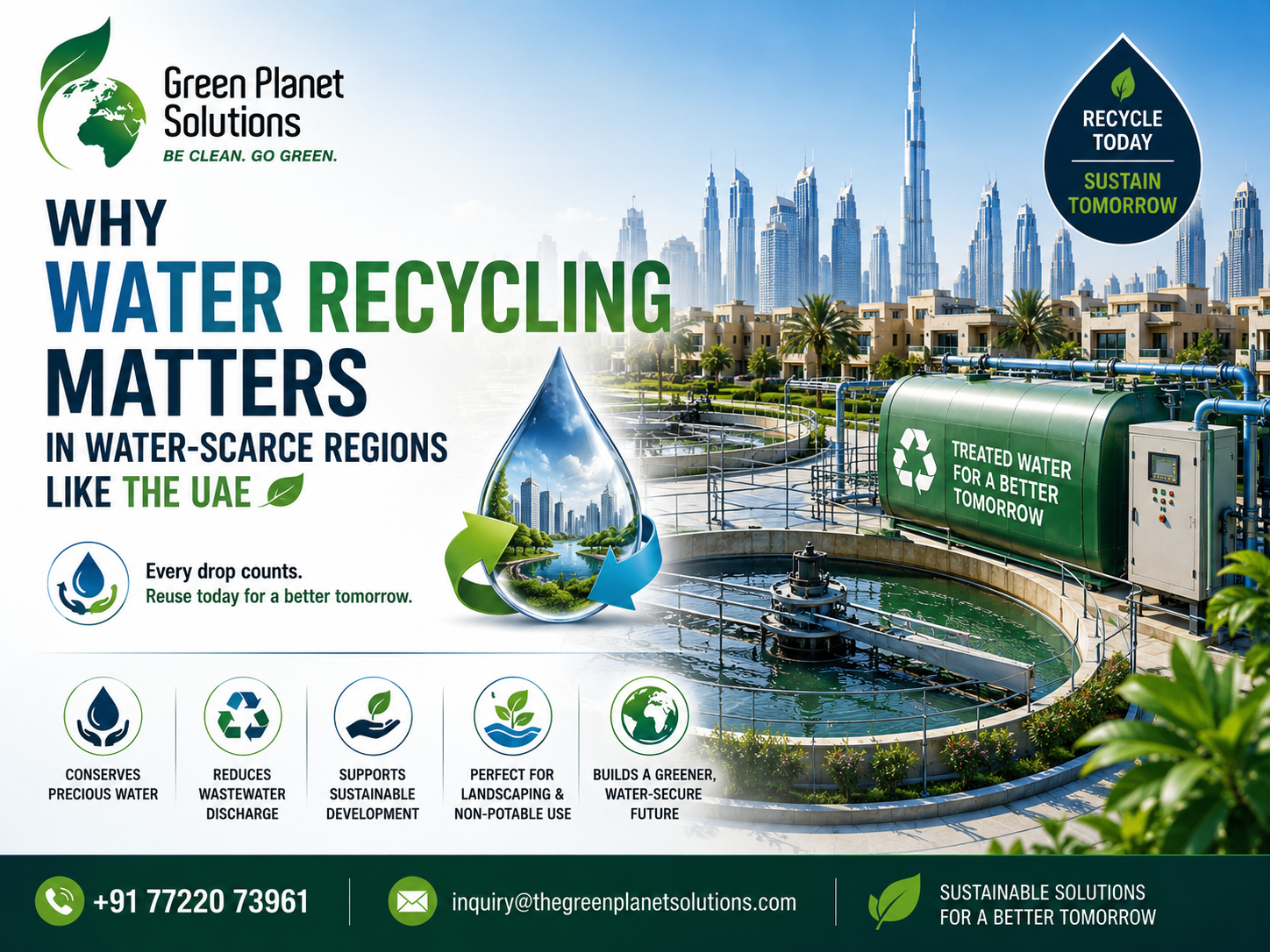
Turning Wastewater into a Valuable Resource for a Sustainable Future
The UAE has transformed rapidly into a modern and highly developed region, with growing cities, residential communities, hotels, industries, and commercial buildings. But this development also brings a major challenge: water demand continues to increase in a region where natural freshwater resources are limited. Water recycling offers a practical way to use existing water resources more efficiently and reduce unnecessary freshwater consumption.
Understanding Water Scarcity in the UAE
The UAE has a naturally dry climate, limited rainfall, and very few renewable freshwater resources. At the same time, water is required every day for households, landscaping, construction, hospitality, commercial activities, and industrial operations.
This makes responsible water management extremely important. Instead of using fresh water for every application, treated wastewater can be considered for suitable non-potable uses when it meets the required quality and applicable regulations.
What Is Water Recycling?
Water recycling is the process of treating used water so that it can be safely reused for appropriate applications.
In residential communities, hotels, commercial buildings, and other facilities, wastewater can be collected and treated through a Sewage Treatment Plant (STP). Depending on the treatment quality and intended application, the treated water may be reused for purposes such as landscaping, irrigation, toilet flushing, cleaning, and other approved non-potable applications.
The goal is simple: use water more than once wherever it is technically and legally appropriate.
Why Is Water Recycling Important for the UAE?
1. Reduces Dependence on Freshwater
Not every activity in a building requires potable water. Landscaping, irrigation, and toilet flushing, for example, may use appropriately treated reclaimed water where permitted.
Using recycled water for suitable applications can reduce the demand for fresh water and improve overall water-use efficiency.
2. Supports Sustainable Urban Development
The UAE continues to develop large residential communities, hotels, commercial buildings, and infrastructure projects.
Water recycling can become an important part of sustainable building and community planning by helping manage wastewater while reducing the pressure on freshwater resources.
3. Helps Reduce Wastewater Discharge
Instead of treating wastewater solely as something that needs to be disposed of, treatment and reuse allow facilities to recover a useful water resource.
A well-designed wastewater treatment system can reduce pollutants before discharge and, where appropriate, produce treated water for reuse.
4. Supports Landscaping and Irrigation
Landscaping is an important part of many UAE residential communities, hotels, resorts, and commercial developments. Maintaining green spaces can require significant quantities of water.
Where regulations and water-quality requirements permit, properly treated recycled water can be used for suitable irrigation applications, helping reduce the use of freshwater for landscaping.
5. Helps Businesses Improve Water Efficiency
Hotels, restaurants, residential communities, hospitals, and commercial buildings can generate substantial amounts of wastewater.
For these facilities, wastewater treatment and recycling can form part of a broader water-management strategy. Better water efficiency can also help organizations manage their resources more responsibly over the long term.
How Does an STP Support Water Recycling?
A Sewage Treatment Plant plays an important role in converting wastewater into treated water.
Although the exact process depends on the technology selected, a typical STP may include:
Screening: Removes larger solids and unwanted materials from incoming sewage.
Biological Treatment: Microorganisms break down biodegradable organic matter in the wastewater.
Clarification: Suspended biological solids are separated from the treated water.
Filtration: Additional treatment can improve water quality depending on the intended application.
Disinfection: Disinfection may be used to control microorganisms and meet the required treated-water quality.
After treatment, the water can be evaluated for approved reuse or discharge applications according to the applicable requirements.
Water Recycling in Residential Communities
Large residential communities can benefit significantly from centralized wastewater treatment and recycling.
Wastewater generated from apartments, villas, bathrooms, kitchens, and other domestic activities can be collected and treated through a centralized STP. The resulting treated water may then be considered for suitable non-potable uses.
This approach creates a more efficient water cycle:
Fresh Water → Residential Use → Wastewater → STP Treatment → Treated Water → Suitable Reuse
Instead of using fresh water once and discarding it, communities can explore opportunities to recover and reuse water responsibly.
Water Recycling for Hotels and Commercial Buildings
Hotels and commercial buildings have continuous water requirements for guest facilities, kitchens, housekeeping, landscaping, and other operations.
An effective wastewater treatment and recycling system can help these facilities manage wastewater more efficiently. Depending on the treated-water quality and applicable regulations, recycled water may support approved non-potable applications within the property.
For businesses focused on sustainability, water recycling can also form part of their broader environmental strategy.
Important Factors Before Implementing Water Recycling
Water recycling should always be planned according to the specific requirements of a project.
Assess Wastewater Generation
Understand how much wastewater the facility generates every day and how this changes during peak periods.
Define the Reuse Application
Determine exactly where the treated water will be used. Different applications can require different levels of treatment.
Select the Appropriate Technology
STP technology should be selected according to wastewater characteristics, required treatment quality, available space, energy requirements, and operational needs.
Consider Operation and Maintenance
Regular monitoring, cleaning, equipment maintenance, and process control are essential for consistent treatment performance.
Follow Applicable Regulations
Treated wastewater must meet the relevant quality requirements for its intended use. Project owners should ensure that the treatment and reuse strategy complies with applicable local regulations and approvals.
The Future of Water Recycling in the UAE
As the UAE continues to grow, water efficiency will become increasingly important. The future of water management is not only about finding new water sources—it is also about making better use of the water already available.
Water recycling, wastewater treatment, desalination, conservation, and smart water-management technologies can work together to create a more resilient water system.
For residential communities, hotels, industries, and commercial facilities, investing in appropriate wastewater treatment and reuse systems can be an important step toward long-term sustainability.
Green Planet Solutions – Supporting Smarter Water Management
At Green Planet Solutions, we provide wastewater treatment solutions designed for residential, commercial, hospitality, institutional, and industrial applications.
Our STP solutions help organizations approach wastewater management with a focus on efficient treatment, water reuse, environmental responsibility, and sustainable operations.
If your project is looking for a wastewater treatment solution, the right system should be selected based on the project’s capacity, wastewater characteristics, treated-water requirements, available space, and intended reuse applications.
📞 +91 77220 73961
📧 inquiry@thegreenplanetsolutions.com
Conclusion
Water recycling matters in the UAE because every drop of water has value. In a water-scarce region, treating and responsibly reusing wastewater can help reduce freshwater demand, support sustainable communities, and improve overall water-management practices.
With the right STP technology, treatment process, operation, and reuse strategy, wastewater can become more than something to dispose of—it can become a valuable resource for a more sustainable future.
Treat wastewater. Reuse responsibly. Build a water-secure tomorrow. 🌱💧