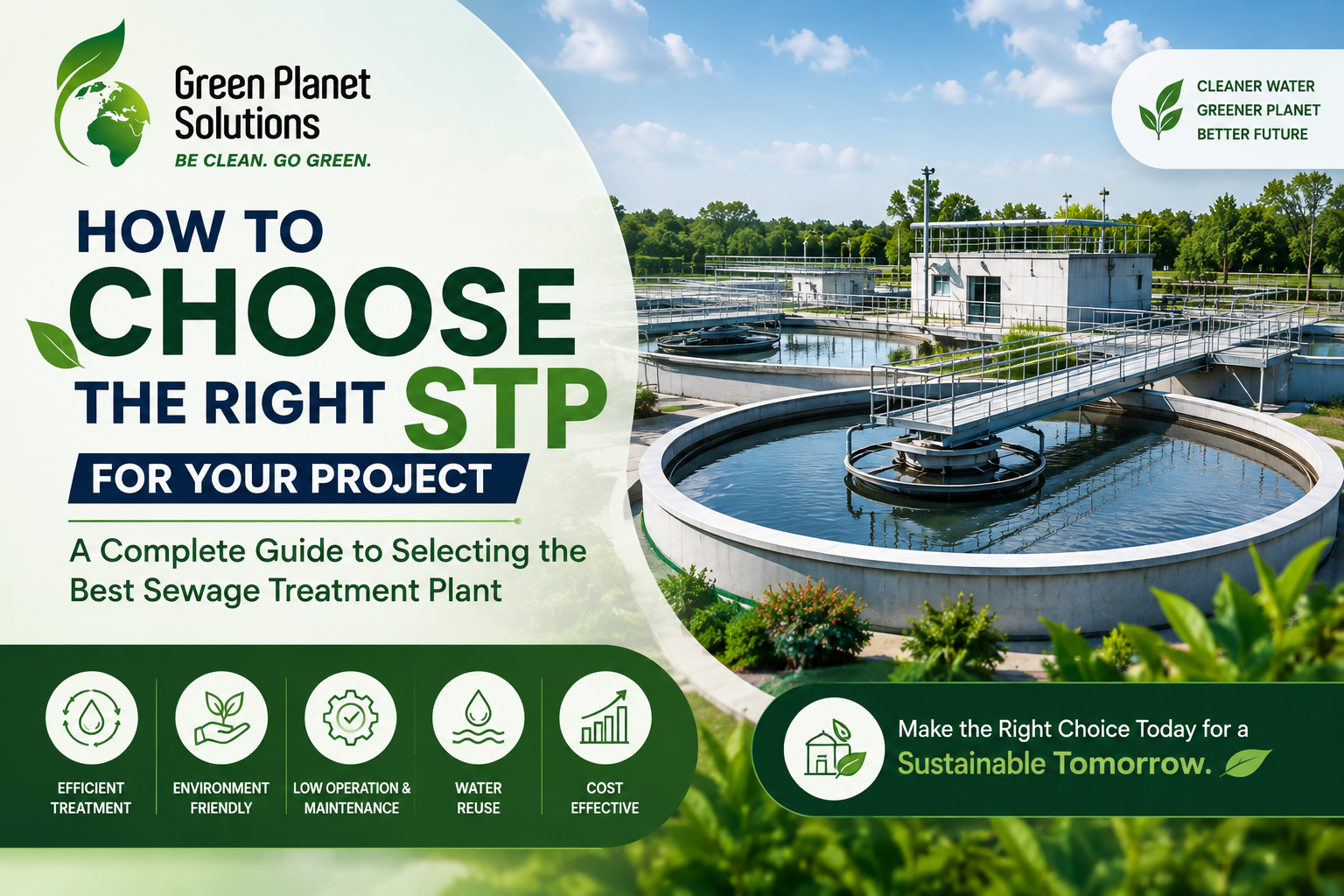
A Complete Guide to Selecting the Best Sewage Treatment Plant STP for Efficient Wastewater Management
Choosing the right Sewage Treatment Plant (STP) is one of the most important decisions for any residential, commercial, or industrial project. An appropriately designed STP not only treats wastewater effectively but also helps conserve water, reduce operating costs, and ensure compliance with environmental regulations.
With several treatment technologies and capacities available, selecting the right system can seem overwhelming. This guide explains the key factors you should consider before investing in an STP.
Why Choosing the Right STP Matters
An STP is a long-term investment that directly impacts your project’s operational efficiency and environmental sustainability. Selecting the wrong capacity or technology can lead to higher maintenance costs, poor treatment performance, and future expansion challenges.
A properly designed STP ensures reliable wastewater treatment, water reuse opportunities, and long-term cost savings while protecting the environment.
Understand Your Wastewater Requirements OF STP
The first step is to estimate how much wastewater your facility generates each day. This depends on the type of project, the number of occupants, and daily water consumption.
For example:
- Residential Apartments
- Hotels and Resorts
- Hospitals
- Commercial Buildings
- Shopping Malls
- Educational Institutions
- Industrial Facilities
Each project has different wastewater characteristics and treatment requirements. Understanding your daily sewage flow helps determine the appropriate STP capacity.
Select the Right Treatment Technology
Different projects require different wastewater treatment technologies. Choosing the right one depends on available space, water quality requirements, operating costs, and maintenance preferences.
Some commonly used STP technologies include:
MBBR (Moving Bed Biofilm Reactor)
MBBR technology is known for its compact design, efficient biological treatment, and low maintenance. It is suitable for hotels, commercial buildings, residential societies, and institutions.
SBR (Sequencing Batch Reactor)
SBR offers high-quality treated water and is ideal for projects where water reuse is a priority. It is widely used in residential townships and municipal wastewater treatment.
MBR (Membrane Bioreactor)
MBR combines biological treatment with membrane filtration to produce exceptionally clean treated water. It is an excellent choice for industries, hospitals, and facilities with stringent water quality requirements.
Consider Future Expansion
Your project may grow over time, increasing the amount of wastewater generated.
Choosing an STP that can be upgraded or expanded later helps avoid costly replacements in the future. Planning ahead ensures your wastewater treatment system remains efficient as your business grows.
Evaluate Available Installation Space
Space availability plays a major role in selecting the right STP.
Compact packaged sewage treatment plants are ideal for projects with limited space, while larger facilities may accommodate conventional treatment systems.
Always consider installation access, maintenance space, and future servicing requirements before finalizing your design.
Focus on Water Reuse
Modern STPs allow treated water to be reused for:
- Landscape Irrigation
- Toilet Flushing
- Cooling Towers
- Gardening
- Car Washing
- Industrial Processes
If water conservation is one of your project goals, choose an STP designed to produce high-quality treated water suitable for reuse.
Energy Efficiency Matters
An energy-efficient STP helps reduce long-term operating costs.
Look for systems that offer:
- Low power consumption
- Automatic operation
- Intelligent control systems
- Efficient aeration technology
- Optimized pumping systems
Lower energy usage results in better operational efficiency and improved sustainability.
Easy Maintenance and Operation
A modern STP should be simple to operate and maintain.
Key features to look for include:
- Automatic control panel
- Durable construction
- Easy access for servicing
- Low sludge generation
- Reliable equipment
- Minimal operator intervention
A user-friendly system reduces downtime and maintenance expenses.
Choose a Reliable Manufacturer
The quality of your STP depends not only on the technology but also on the expertise of the manufacturer.
Work with a company that provides:
- Customized system design
- Quality manufacturing
- Professional installation
- Commissioning support
- Operator training
- After-sales service
- Annual Maintenance Contracts (AMC)
A trusted manufacturer ensures long-term performance and dependable support.
Why Choose Green Planet Solutions?
Green Planet Solutions offers advanced Sewage Treatment Plants designed for residential, commercial, industrial, and institutional applications.
Our STP solutions are built using modern treatment technologies such as MBBR, SBR, and MBR to deliver reliable performance, energy efficiency, and high-quality treated water.
We provide complete support—from system design and installation to maintenance and technical assistance—helping our customers achieve efficient wastewater management and long-term sustainability.
Conclusion
Choosing the right Sewage Treatment Plant is essential for ensuring efficient wastewater treatment, reducing operating costs, conserving water, and supporting sustainable development.
By evaluating your wastewater volume, selecting the right technology, planning for future expansion, and partnering with an experienced manufacturer, you can invest in an STP that delivers reliable performance for years to come.
Green Planet Solutions is committed to providing innovative and customized wastewater treatment solutions that help businesses and communities build a cleaner, greener, and more sustainable future.
Build Smarter Water Solutions with Green Planet Solutions
Whether you’re planning a residential project, commercial complex, hotel, hospital, or industrial facility, our experts can help you select the ideal STP for your requirements. Contact Green Planet Solutions today and take the first step toward efficient wastewater management and sustainable growth.