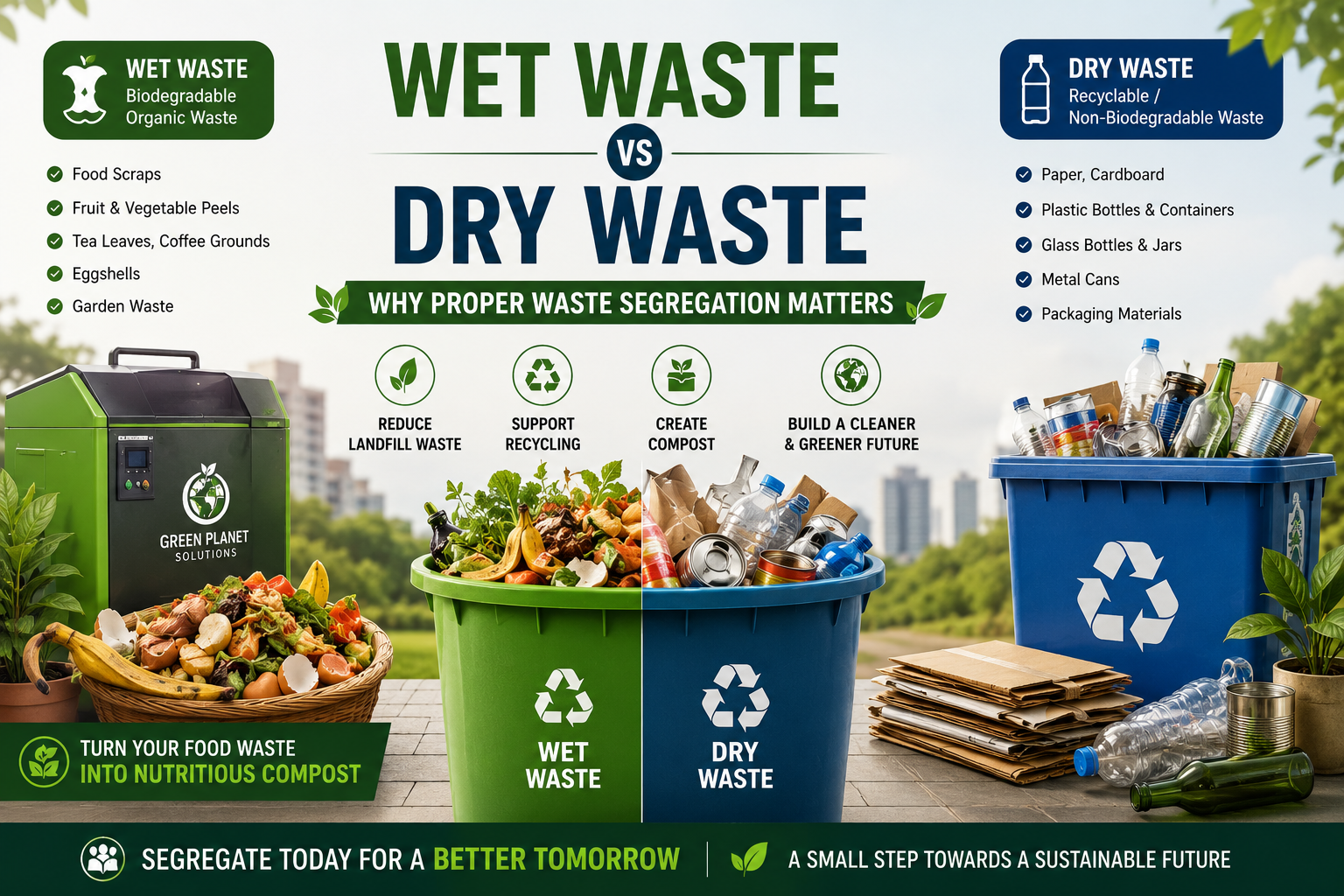
Housing societies can make wet-waste handling more reliable when they treat it as an everyday operating process, rather than only an equipment purchase. A workable plan starts with knowing how much material is generated, where it is collected, who is responsible at each step, and what will happen to the processed material.
This guide gives a practical structure for resident welfare associations, committee members, facility managers, and housekeeping teams. The exact system should be selected only after a site assessment, because quantity, available space, local collection arrangements, staffing, and local rules differ from one property to another.
1. Estimate the daily wet-waste quantity
Begin with a short measurement exercise. For seven representative days, ask the housekeeping team to separately record food scraps, fruit and vegetable waste, garden waste, and contaminated mixed waste from common areas. Record the approximate weight or number of containers, along with unusual events such as functions, holidays, or low occupancy.
The objective is not a perfect laboratory measurement. It is to establish a realistic daily range and identify peak days. This information helps the society compare processing options and plan storage and collection capacity.
Useful information to record includes:
- number of occupied flats and approximate residents;
- wet-waste quantity by day;
- garden-waste quantity, if handled separately;
- collection timings and collection-point location;
- current municipal collection arrangement; and
- available covered space, power, drainage, and staff availability.
2. Make segregation simple for residents and staff
Wet-waste processing works best when the input is reasonably clean. The society should make the expected household behaviour easy to understand: keep food waste separate from dry recyclables, sanitary waste, e-waste, glass, and hazardous items.
Use clear bin labels with examples rather than only technical terms. Place the same instructions at lift lobbies, collection points, and in resident communication groups. Housekeeping staff should have a short, consistent procedure for what to do when a bag is mixed or contains unsuitable material.
A short message, repeated consistently, is more useful than a detailed one-time circular.
3. Design the collection point before selecting equipment
A collection point should support safe, clean daily work. Confirm where waste will be brought, whether the area is covered, how containers will be cleaned, and how staff will move material without crossing inconvenient routes or creating odour issues near homes.
Before commissioning any system, inspect:
- access route from towers and common areas;
- floor surface, water supply, drainage, and electrical connection where relevant;
- ventilation and housekeeping arrangements;
- distance from sensitive locations such as entrances, play areas, and windows; and
- how the society will store material temporarily during maintenance or peak days.
The best location is not necessarily the largest unused corner. It is a space that can be operated, cleaned, supervised, and accessed every day.
4. Assign operating roles clearly
Many projects slow down because the equipment is delivered but daily ownership is unclear. Write down who is responsible for collection, inspection of input material, loading, cleaning, record keeping, compost handling, and escalation when a problem occurs.
For a typical society, the committee or facility manager can own oversight, while a named housekeeping supervisor owns the day-to-day checklist. The maintenance team should know whom to contact if power, drainage, or mechanical support is needed. The vendor or solution provider should be contacted through the agreed support route for issues that require specialist assistance.
Keep a simple daily log. It can record approximate incoming quantity, contamination observed, operating time, output handling, and any issue requiring follow-up. The record is valuable during handover, committee changes, and performance reviews.
5. Compare processing routes using site facts
The right route depends on the actual site. Some societies may use an on-site organic-waste composter; others may use decentralised composting, authorised collection, or a combination with separate handling of garden waste. The choice should account for the expected quantity, space, staffing, budget, desired output, and the downstream use or removal of processed material.
Do not select capacity using only the number of flats. Occupancy, food habits, events, common kitchens, and garden waste can change daily volumes. Use the measured daily range and allow for realistic operation and maintenance rather than assuming ideal input quality.
For a starting point, review the Best Organic Waste Composter in India guide and the fully automatic composting machine solution page. A site discussion can then match the option to your actual operational requirements.
6. Prepare a commissioning checklist
Before the system begins regular operation, confirm that the society has:
- a named owner for daily operation and another for backup;
- resident and staff segregation instructions;
- containers, cleaning materials, and personal protective equipment appropriate to the task;
- a collection schedule and a covered temporary-holding arrangement;
- an operating and maintenance checklist;
- a plan for compost or processed output; and
- a support and escalation contact path.
Start with a supervised first week. Review the incoming material daily and solve contamination or collection problems early. A gradual, visible start usually produces better resident cooperation than silently launching a process and correcting it later.
Common mistakes to avoid
The most common issues are mixed waste at source, an inconvenient collection point, no named operator, unrealistic capacity assumptions, and no plan for the output. Another avoidable problem is treating resident communication as complete after one announcement. New residents, staff turnover, and changing habits mean the message needs occasional reinforcement.
Request a practical site assessment
Green Planet Solutions can discuss a suitable next step using your resident count, approximate daily wet-waste quantity, available space, city, and preferred operating model. Call +91 7722073961 or email inquiry@thegreenplanetsolutions.com. For a structured enquiry, use the existing project-enquiry route.
This article is practical operational guidance. Confirm applicable local requirements and site-specific technical details before implementing a waste-management system.
Leave a Reply